
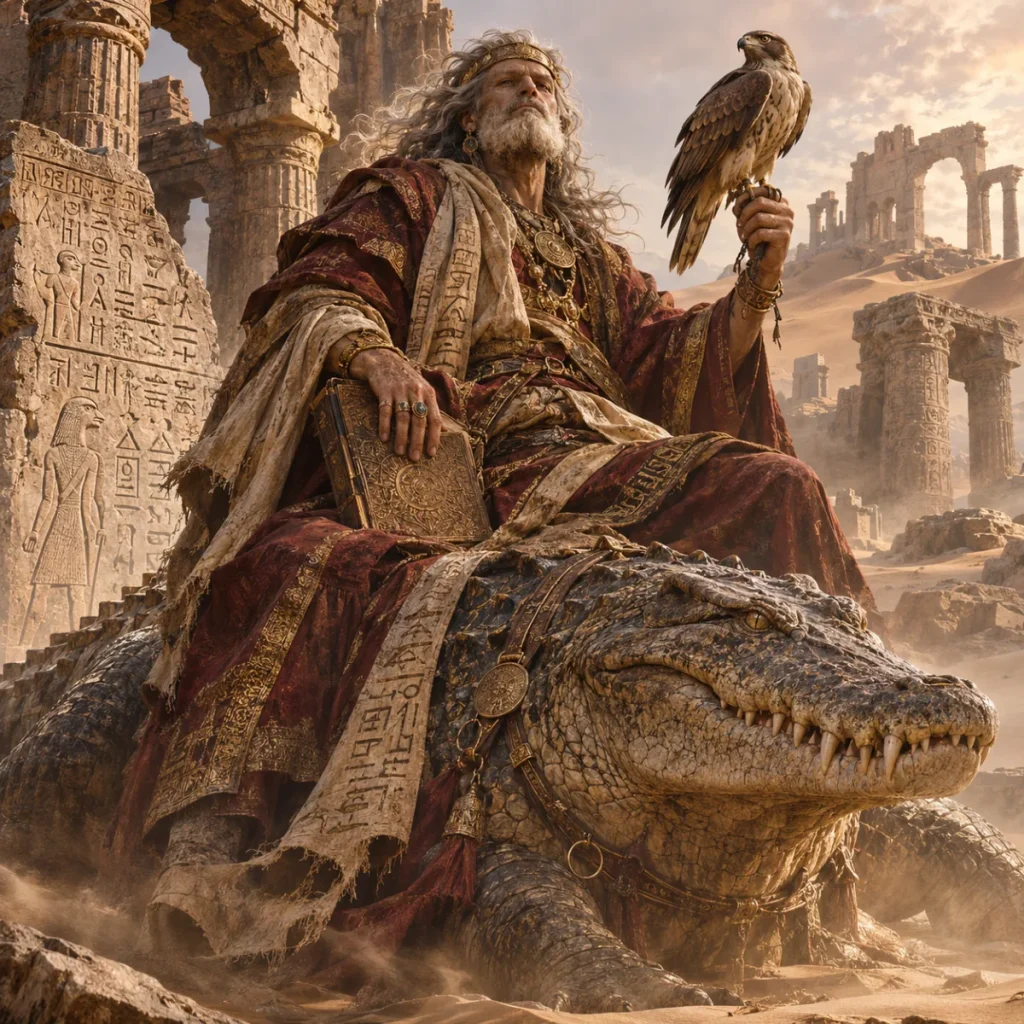
A fair old man riding a crocodile, with a goshawk perched on his fist. Few entries in the Ars Goetia paint as clear a picture as that of Agares, the second of the catalog’s 72 spirits.
To that almost serene image the grimoire adds outsized powers: teaching any language on the spot, bringing runaways back and shaking the earth. Read alongside its Latin source, the entry also shows how a translation error can harden into tradition.
Who is Agares in the Ars Goetia?
In the transcription of Sloane MS 3825 published by Joseph H. Peterson, Agares is a duke “under ye power of ye East,” the same direction the text links to Bael, the spirit who opens the list. He governs 31 legions and, according to the text, “was of the order of Vertues,” one of the angelic choirs. In other words, the grimoire imagines him as a fallen angel who still holds a noble title in the infernal hierarchy.
What does Agares look like?
The manuscript says he “cometh up in the form of a fair Old man riding upon a Crocodill, very mildly, carrying a goshawke on his fist.” That adverb matters: Agares does not burst in raging, as other spirits in the catalog do, but arrives in a gentle mood.
The goshawk was a bird of prey used in falconry in the Europe of the period. The text says nothing more about his clothing, his face or the size of the crocodile; anything else in a modern illustration is the artist’s choice.
What powers does the grimoire attribute to Agares?
The list is short but ambitious. According to the Ars Goetia, Agares:
- “maketh them runne that stand still, and fetcheth back ye runnawayes”;
- “can teach all Languages or Tongues presently,” that is, at once;
- has power to destroy dignities, “both supernaturall & Temporall”;
- causes earthquakes.
As with the whole catalog, these are literary attributions from an early modern magical text, not proven abilities. What makes them interesting is what they reveal: instant language teaching answers a very concrete wish in a Europe where Latin, Greek and Hebrew were the keys to learning.
Agares in Weyer: the earthquakes that weren’t there
Agares also stands second in Johann Weyer’s Pseudomonarchia Daemonum (1577), where he is “the first duke under the power of the east,” with the same 31 legions and the same order of Virtues. The old man on the crocodile with a bird of prey in hand is already there.
The differences lie in the details. Where the English text speaks of earthquakes, Weyer’s Latin reads tripudiare facit spiritus terrae: “he makes the spirits of the earth dance.” Reginald Scot’s English translation (1584) turned this into “hee maketh earthquakes,” and the Ars Goetia inherited that reading. Something similar happened with the dignities: Weyer speaks of praelaturas et dignitates, prelacies and dignities, and the qualifier “supernatural and temporal” is an addition of the English version that Peterson marks as foreign to the original.
The seal of Agares
The manuscript accompanies the entry with a seal or character which, according to the text, was to be worn as a lamen. Peterson notes a curious detail: beside the drawing, a second hand wrote “King Agares,” as if he were a king, even though the text calls him a duke without any ambiguity. It is a good reminder that manuscripts pile up corrections and comments from different readers.
Why Agares still stands out
Agares condenses the appeal of the Ars Goetia into a few lines: a memorable image, powers that touch on rank and knowledge, and a textual history you can actually trace. His entry lets us follow, almost word for word, the road from Weyer’s Latin to Scot’s English and from there to the Lemegeton. To explore the rest of the catalog, the Ars Goetia index brings together all 72 spirits.
