
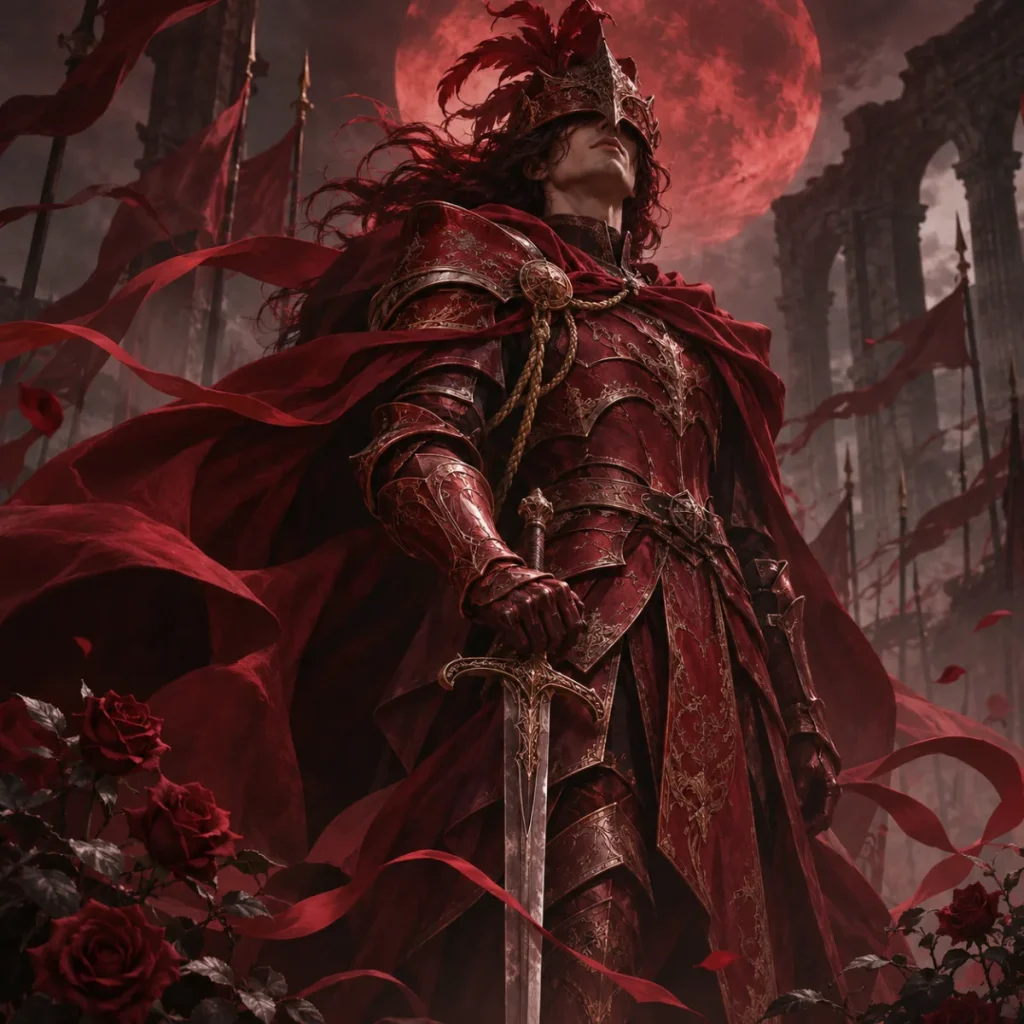
A soldier dressed in red and armed for war, though his business has nothing to do with battle. Zepar, the 16th spirit of the Ars Goetia, carries one of the grimoire’s most striking paradoxes: the same power that brings lovers together can also leave them childless.
Who is Zepar in the Ars Goetia?
In Joseph H. Peterson’s transcription of Sloane MS 3825, Zepar is “a great duke” who governs 26 legions of “Inferiour spirits.” He holds sixteenth place in the list of the 72 spirits of the Lemegeton.
That rank and those legions belong to the imaginary court the book sets up, and the same goes for everything that follows: these are the grimoire’s attributions, not abilities anyone has ever verified.
What does Zepar look like?
The description is brief: he “appeareth in red apparell and armed like a souldier.” The color belongs to his clothing. The text never says the armor is red, and it says nothing about his face, his mount or the kind of weapons he carries. Any more detailed portrait, however appealing, is the illustrator’s choice.
What powers does the grimoire attribute to Zepar?
According to the manuscript, his office is “to cause women to love Men and to bring them togather in love.” In the same breath it adds: “he also maketh them barren.” Union and barrenness end up bound together in a single spirit.
Notice that the text speaks of women only as the objects of the action, never as the ones seeking it. That is a mark of the period and of the genre, not a minor detail: love appears as something a third party can bring about from the outside.
It is worth comparing him with Sallos, the 19th spirit, to whom the same book attributes the love “of women to men and men to women”: in both directions, and with no mention of barrenness.
Zepar in Weyer: what the Lemegeton left out
Zepar already appears, as number 19, in Johann Weyer’s Pseudomonarchia Daemonum (1577), one of the direct forerunners of the Ars Goetia. There he is also a great duke with 26 legions, but the entry differs on two points:
- Weyer describes him only “as a soldier,” without the red that the English manuscript adds.
- Weyer gives him one more power: when commanded, he transforms the shape of women “until they enjoy their beloved.” The Lemegeton drops that shape-changing and keeps only love and barrenness.
The comparison shows that the catalog was not copied wholesale: the English compiler trimmed some details and added others.
Zepar’s seal
Like each of the 72, Zepar has his own seal in the manuscript, and the text says something specific about it: it is the sign “which he obeyeth when he seeth it.” We don’t reproduce it here. Anyone who wants to study it should turn to the documentary edition, which makes it possible to compare the variants across copies.
What Zepar reveals
In a few lines, Zepar distills a very old anxiety: the idea that desire can be manipulated, and that the manipulation comes at a price. One possible reading is that barrenness works as a moral warning inside the grimoire’s own fiction. That is an interpretation, not something the text explains. What the entry does show is how love was imagined by the culture that produced these catalogs.
