
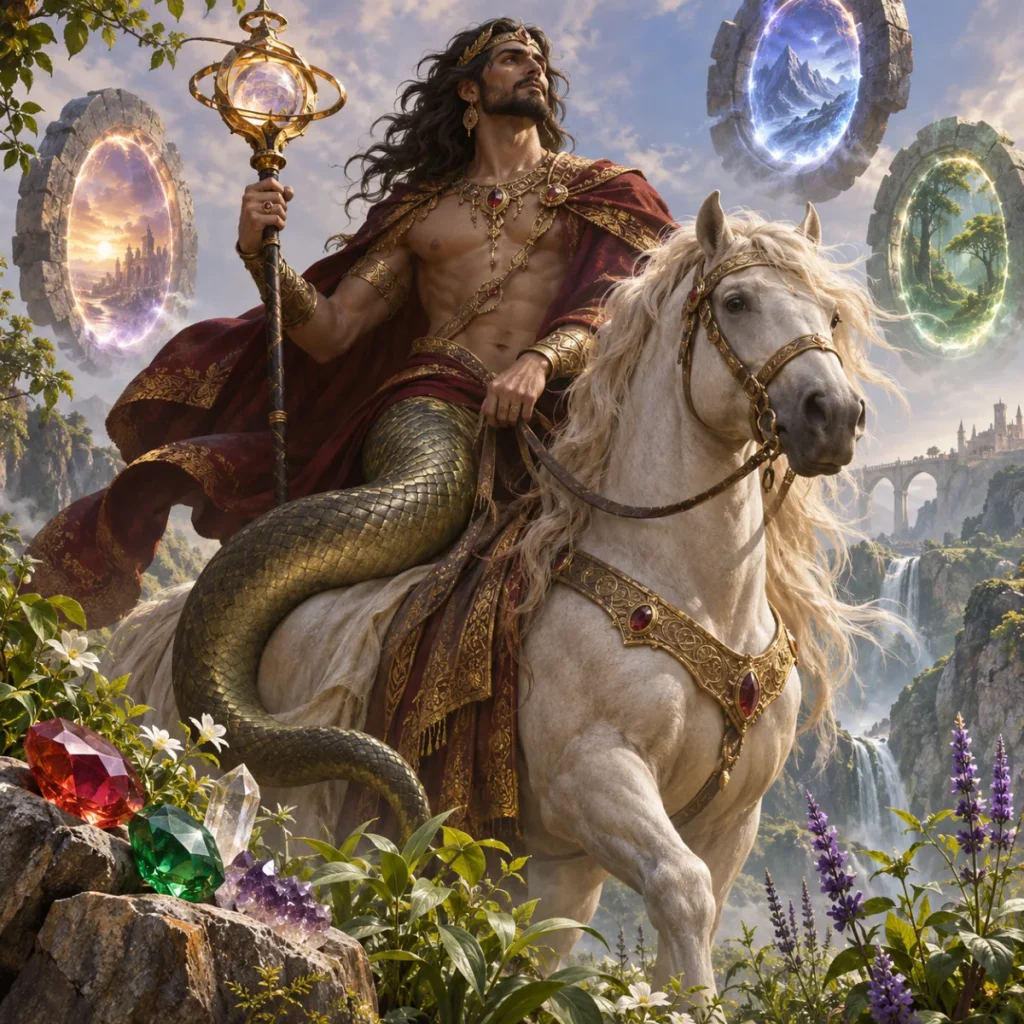
A burly man with a serpent’s tail, seated on a pale horse. Bathin, the 18th spirit of the Ars Goetia, combines two very different gifts: he knows the virtues of plants and stones, and he can carry a person from one country to another in an instant.
Who is Bathin in the Ars Goetia?
In Joseph H. Peterson’s transcription of Sloane MS 3825, Bathin is “a mighty and strong duke” who rules over 30 legions of spirits. He stands eighteenth among the 72 spirits of the catalog.
His title, his legions and his powers belong to the book’s internal logic. They are attributions of an early modern grimoire, not proven abilities.
What does Bathin look like?
The text is precise: he appears “like a strong man with the Taile of a serpent, sitting on a paile couloured horse.” It describes neither his face nor his clothing, nor the horse beyond its color.
It is easy to connect the pale horse with the fourth horseman of the Apocalypse. The link is suggestive, but the grimoire never makes it, so it is best treated as the reader’s association rather than something in the text.
What powers does the grimoire attribute to Bathin?
The manuscript assigns him two:
- He “knoweth the vertue of hearbes and precious stones.”
- He “can transport men suddenly from one Country into an other.”
The first places him in the tradition of natural magic, which credited plants and minerals with hidden properties. Within the catalog he shares that ground with other spirits: the familiars granted by Marax know those same virtues, and Stolas teaches the virtues of herbs and stones along with astronomy.
The second power is more unusual. Getting from one country to another without traveling the road in between was a potent fantasy in an age of long and dangerous journeys.
Bathin in Weyer: Bathym or Marthim
Bathin appears as number 10 in Johann Weyer’s Pseudomonarchia Daemonum (1577), where he is called “Bathym, alibi Marthim,” that is, Bathym, known elsewhere as Marthim. Reginald Scot’s English translation turns him into “Bathin, sometimes called Mathim,” and that is where the Lemegeton’s form comes from.
The content matches almost word for word: a great and strong duke, a serpent’s tail, a pale horse, herbs and stones, 30 legions. Weyer’s Latin specifies that the transport happens “at the swiftest pace,” a nuance the English manuscript boils down to a simple “suddenly.”
The seal of Bathin
The entry ends with his seal and an instruction from the text itself: it is “thus to be made and to be worne before you.” This idea of the seal as an object to be carried, not just a drawing, recurs in many entries of the catalog.
What Bathin reveals
Bathin pairs the patient knowledge of the herbalist with the wish to abolish distance. That mix sums up what readers of these grimoires were after: useful knowledge and power over the limits of the physical world. The text never explains the serpent’s tail or the pale horse, which leaves room for interpretation, but any symbolic reading should be presented as exactly that.
