
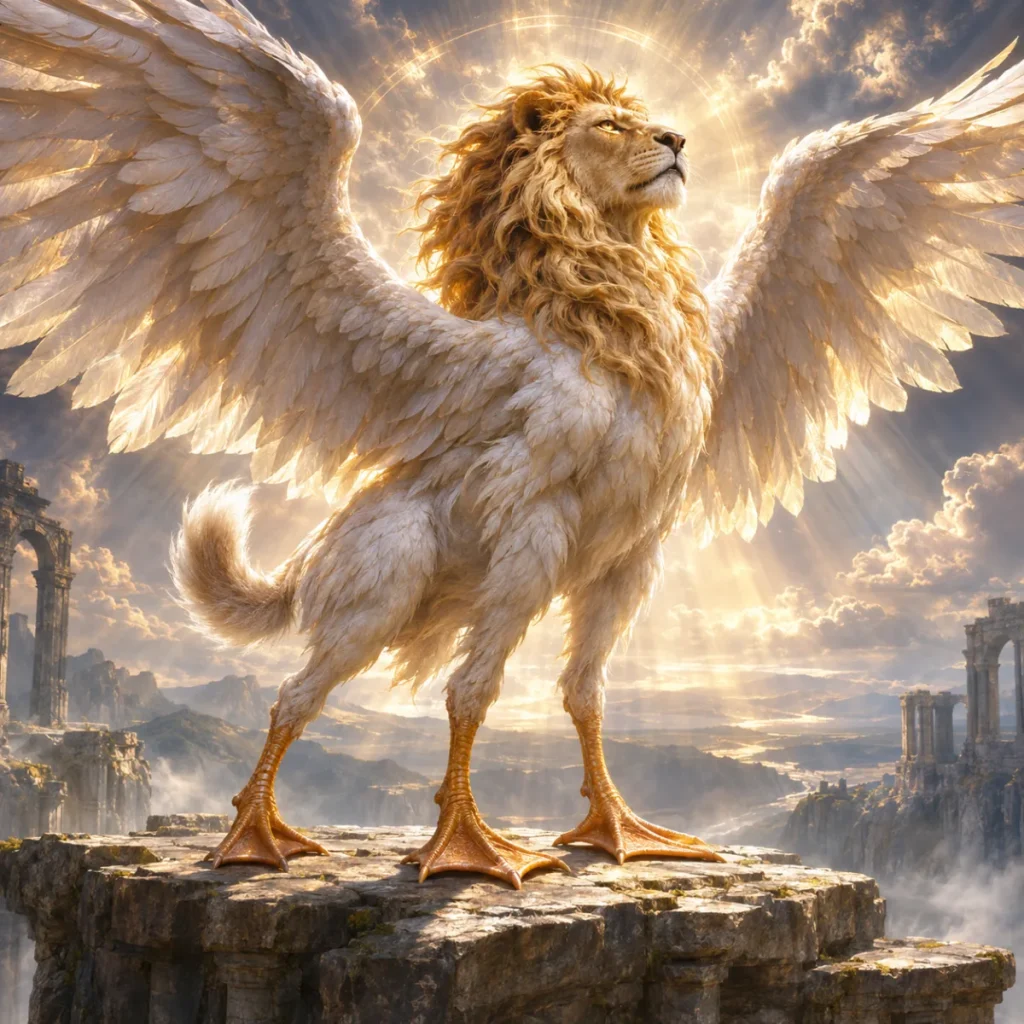
An angel, but with a lion’s head, a goose’s feet and a hare’s tail. Ipos, the 22nd spirit of the Ars Goetia, is one of the most baffling hybrids in the catalog, and his office is almost as simple as his appearance is strange: making people witty and bold.
Who is Ipos in the Ars Goetia?
Joseph H. Peterson’s transcription of Sloane MS 3825 describes him as “an Earle and a mighty prince.” That makes him one of the spirits with a double rank, and he governs 36 legions. He holds 22nd place among the 72 spirits.
Those titles, like his powers, belong to the grimoire’s hierarchy. They are presented here as attributions of the text, not as real powers.
What does Ipos look like?
The manuscript says he appears “in the forme of an angel, with a Lions head, gooses feet and a haires Taile.” The mix is deliberately incongruous: an angelic body combined with a predator, a barnyard bird and an animal associated with running away.
The text doesn’t explain what these pieces mean. Reading the lion’s head as courage and the hare’s tail as speed is tempting, but it is a modern interpretation, not something the grimoire says.
What powers does the grimoire attribute to Ipos?
The Ars Goetia gives him three:
- He “knoweth things past and to come.”
- He makes men “witty,” in the old sense of sharp and quick-minded.
- He makes them “bold.”
Where other spirits promise treasure or love, Ipos offers personal qualities: quickness of mind and courage. His is one of the shortest entries in the catalog.
Ipos in Weyer: Ipes, alias Ayperos
Johann Weyer records him as number 16 of his Pseudomonarchia Daemonum (1577) as “Ipes, alias Ayperos”; Reginald Scot’s English translation writes “Ipos, alias Ayporos,” and that is the source of the Lemegeton’s form. The double rank of earl and prince, the 36 legions and the powers all match.
The difference lies in the tone of the description. Weyer says he appears in angelic form but is in fact “darker and uglier than a lion.” The English manuscript drops that judgment and leaves only the angel with his animal features. Something similar happens with Astaroth, another angel-shaped spirit whom the texts call ugly.
The seal of Ipos
The manuscript calls his sign a “seal or Charecter” that “must be worne as a Lamen before you,” that is, as a plate hung over the operator’s chest. Peterson’s edition reproduces it from the Sloane copy.
Why Ipos matters
Ipos condenses the ambiguity of many spirits in the Ars Goetia: they present themselves as angels, but their bodies give them away as something else. That tension between celestial form and bestial features runs through the whole catalog, which imagines its spirits as fallen angels. In Ipos’s case, moreover, the gift on offer is human and everyday: thinking fast and daring to act.
