
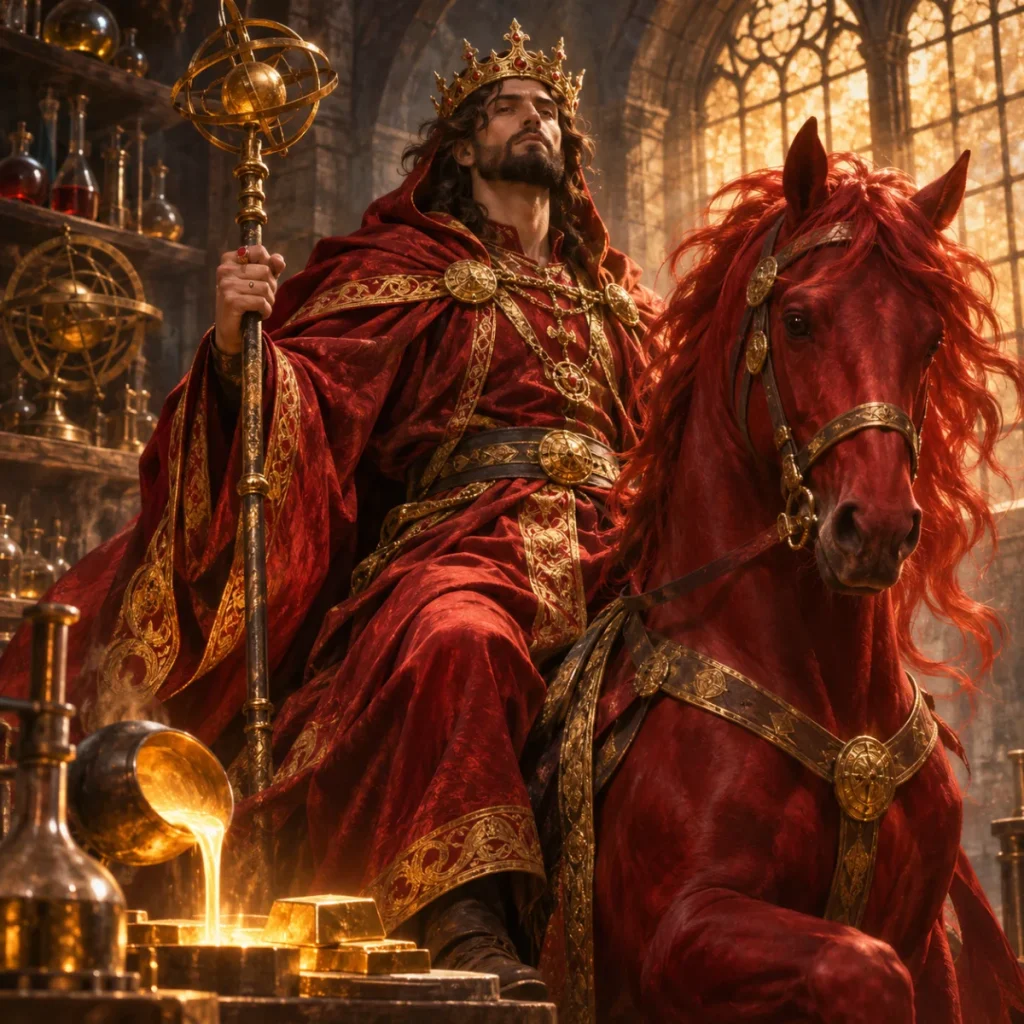
A soldier dressed in red, on a red horse and wearing a crown of gold, able to turn any metal into gold. Berith, the 28th spirit of the Ars Goetia, would be the ideal ally if the grimoire itself didn’t add a warning: he is “a great Lyer and not to be Trusted much.”
Who is Berith in the Ars Goetia?
In Joseph H. Peterson’s transcription of Sloane MS 3825, Berith is “a Mighty great and terrable duke” who governs 26 legions of spirits. He holds 28th place among the 72 spirits. Peterson’s notes indicate that the Folger manuscript places him in the south.
The text adds that he has “two other Names given to him by men of latter Times”: Beal and Bolfry. Rank, names and powers are attributions of the grimoire, not verifiable facts.
What does Berith look like?
He appears “like a souldier with red clothing, ridding on a red horse and a Crown of Gold upon his head.” He speaks “with a very clear and subtill voice.” Red dominates the whole scene: the rider, his clothing and his mount.
What powers does the grimoire attribute to Berith?
According to the Ars Goetia, Berith:
- Gives true answers about things past, present and to come.
- “Can turne all mettals into Gold.”
- “Can give dignity and confirm them to Men.”
And yet the same text calls him a great liar. The contradiction is deliberate: the grimoire warns that even a spirit who answers truly can deceive. The manuscript also points back to the ring described in the entry for Beleth (“you must use a Ring as is before spoken of Beleth”), one of the operator’s protective objects that the grimoire mentions in several entries.
Berith in Weyer: three names
Johann Weyer records him as number 27 of his Pseudomonarchia Daemonum (1577), also as a duke, with the same red appearance, the crown, the transmutation of metals, the dignities, the clear and subtle voice and the 26 legions. The differences:
- Weyer explains the three names differently: “some” call him Beal, “the Jews” call him Berith, and “the necromancers” Bolfri. The Lemegeton simplifies this and assigns Beal and Bolfry to “men of latter Times.”
- Weyer says he is compelled to come at a certain hour, by divine virtue, through a ring of magical art; the English manuscript reduces this to the reference to Beleth’s ring.
Peterson’s notes to Weyer record other forms of the name in related manuscripts, such as Beelferith, Berich and Bertheth.
Where does the name Berith come from?
The name matches that of Baal-berith, “lord of the covenant,” a deity mentioned in the biblical Book of Judges. The connection is plausible, especially since Weyer says “the Jews” call him Berith, but neither source develops it, so it should be taken as a hypothesis rather than a proven origin.
What Berith reveals
Berith closes his entry with a seal that, according to the manuscript, “must be worne as a lamin,” and leaves a lesson that runs through the whole Ars Goetia: a spirit’s power is no guarantee of its reliability. That the same being turns metals into gold and is branded a liar can be read as a warning about greed, though that moral reading is ours; the text doesn’t spell it out.
