
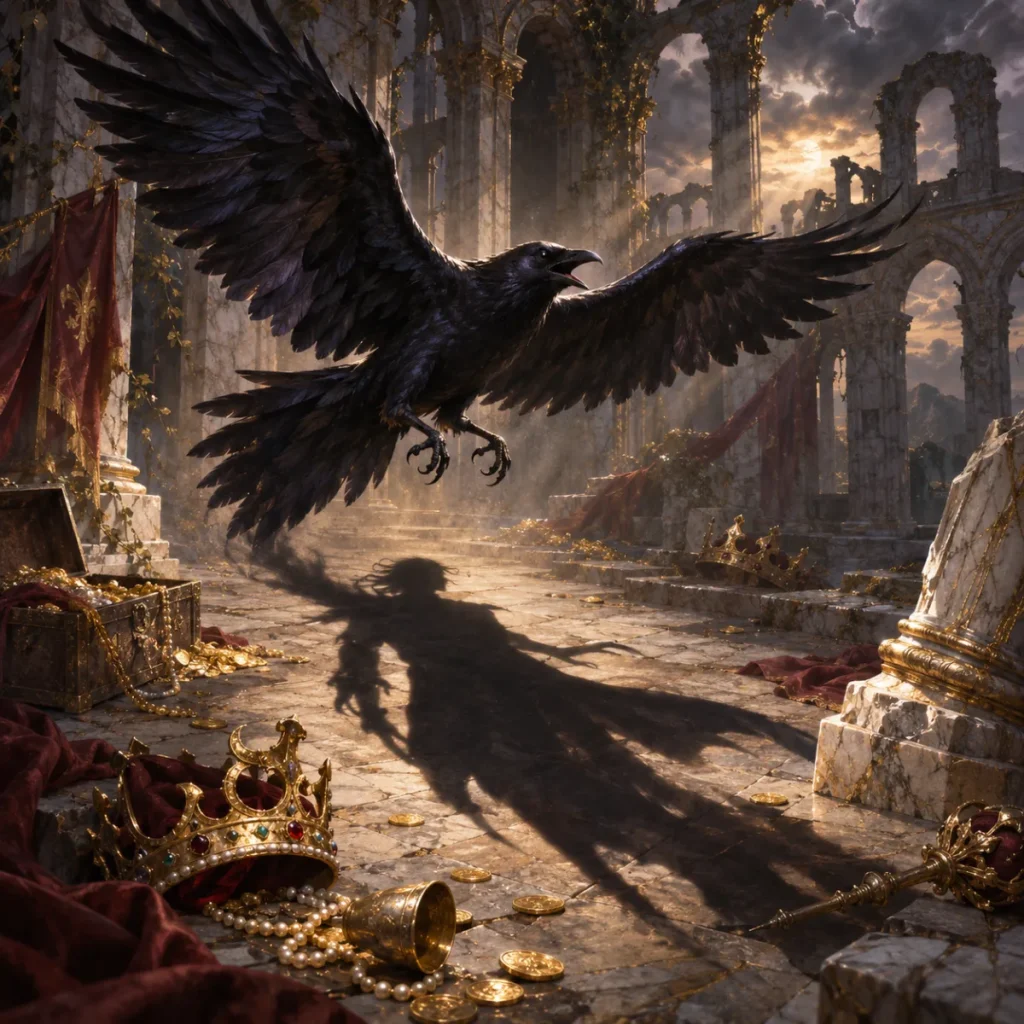
A raven that slips into palaces and flies off with the king’s treasure. The image of Raum, the 40th spirit of the Ars Goetia, seems lifted from a fable, but the grimoire adds other powers that are far less innocent: destroying cities, undermining the standing of the powerful and reconciling enemies.
Who is Raum in the Ars Goetia?
In Joseph H. Peterson’s transcription of Sloane MS 3825, Raum is an Earl; Peterson adds “great,” following Weyer, Reginald Scot’s translation and another English manuscript. He governs 30 legions of spirits and, according to the text, “was of ye order of Thrones,” one of the angelic choirs.
What does Raum look like?
He appears first “in ye forme of a Crow,” and afterward, “at ye command of ye Exorcist he putteth on humane shape.” As with Malphas, the English says “crow,” but Peterson points out that Weyer’s Latin reads corvus, a raven, not cornix, a crow.
There are no further details: no color, no size, no described voice. If an illustration paints him black or gigantic, that is the artist’s decision; the text doesn’t specify it.
What powers does the grimoire attribute to Raum?
Raum’s entry combines theft, destruction and divination. According to the manuscript, “his office is to steale Treasures out of kings houses, and to carry it where he is commanded, & to destroy Citties, and ye dignities of men; & to tell all Things past, & wt is, & wt will be; & to cause Love between friends & foes.”
As throughout the catalog of the 72 spirits of the Ars Goetia, these are attributions of a magical text, not proven abilities. The curious thing is the contrast: the same spirit who lays cities waste is able to reconcile adversaries.
Raum, Raym and Zayme: the name in the sources
In Johann Weyer’s Pseudomonarchia Daemonum (1577), the spirit is entry 42 under the name “Raum vel Raym”; Scot writes “Raum, or Raim.” Peterson also notes that the description matches that of a spirit called Zayme in the Folger manuscript.
Weyer’s content agrees on the essentials: a great earl, the form of a raven, human shape at the exorcist’s command, the destruction of cities, knowledge of past, present and future, the order of Thrones and 30 legions. But there are nuances. The Latin says he steals “from the king’s house or another” (ex regis domo vel alia), not only from royal palaces. And instead of destroying dignities, Weyer says he “instills contempt for dignities” (dignitatum despectum ingerit): he doesn’t wipe them out, he discredits them. Scot puts it as “hath great despite unto dignities.” Finally, the Latin speaks of winning the favor, rather than the love, of friends and foes.
Raum, the raven and power
Raum shares a bird’s form with neighboring spirits, but his sphere is different. If Halphas and Malphas build, Raum dismantles: he plunders royal treasure, destroys cities and erodes prestige. His seal, which the manuscript tells you to “make and weare as a Lamin,” is best reproduced from a documentary edition.
Read as a whole, his entry looks like a small catalog of threats against the social order of the time, with the king, the city and the hierarchy as targets. That the same spirit can then reconcile enemies gives him an ambiguous air that makes him especially interesting.
