
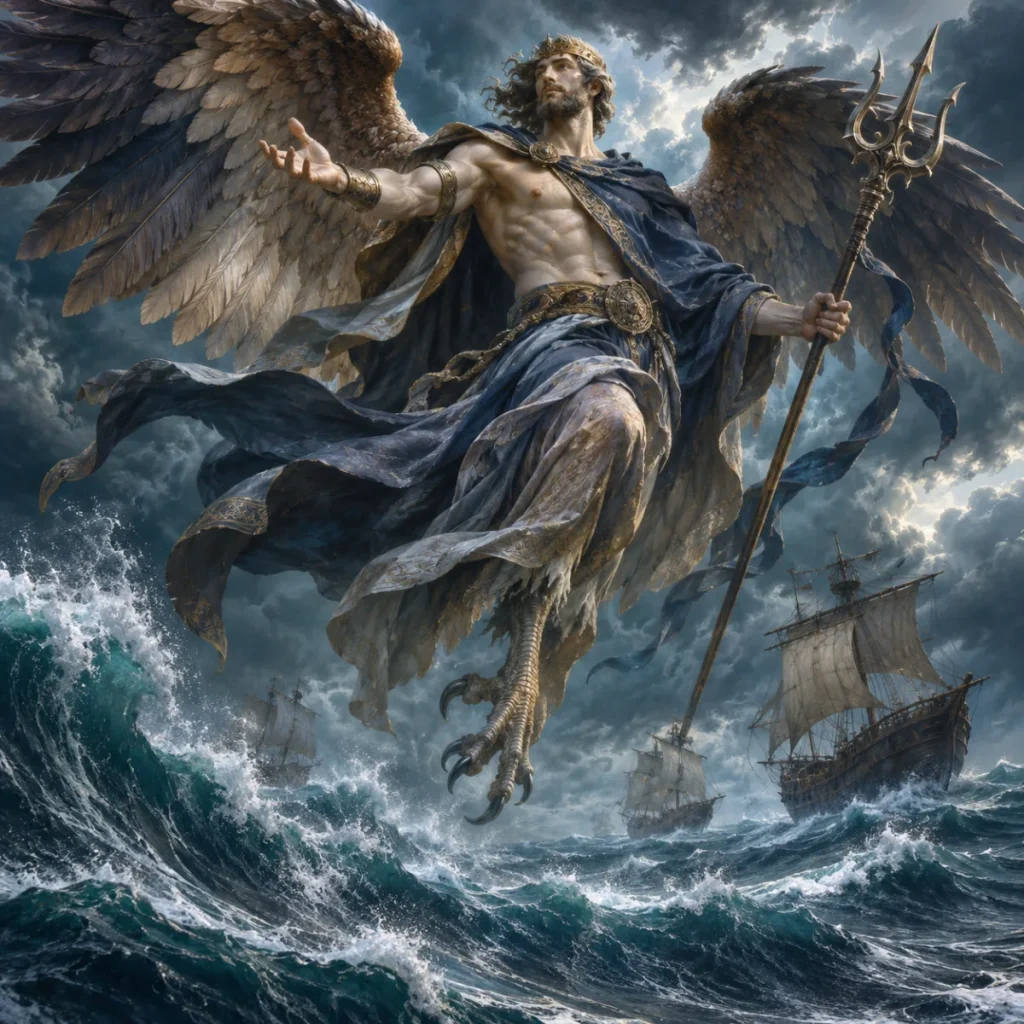
A man with griffin’s wings who commands the winds and the seas, drowns men and overturns warships. Focalor, the 41st spirit of the Ars Goetia, is the catalog’s great lord of storms at sea, and also the protagonist of one of its most curious numerical errors.
Who is Focalor in the Ars Goetia?
In Joseph H. Peterson’s transcription of Sloane MS 3825, Focalor is “a great duke & strong.” The text adds that “he hath hopes to returne to ye 7th Throne after 1000 yeares,” which places him among the spirits the grimoire imagines as fallen angels, although it does not say which choir he came from.
His legions deserve a section of their own, because the English manuscript and Weyer do not give the same number.
What does Focalor look like?
He appears “in ye forme of a Man with griffins wings.” It is a simple image: a human figure with the wings of the creature that is half eagle, half lion. The text mentions no weapons, crown or mount, and it gives him no earlier animal form.
Weyer adds an interesting nuance about the order of events: he says Focalor comes forth as a man with griffin’s wings and that, “having taken human shape” (accepta humana figura), he kills men and plunges them into the waters.
What powers does the grimoire attribute to Focalor?
According to the manuscript, “his office is, to kill men, and to drown them in ye waters, and to over throw ships of warre, for he hath power over both winds and seas.” But the text adds a clause that softens that violence: “he will not hurt any man or Thing, if he be commanded to ye contrary by ye Exorcist.”
Peterson specifies that the correct sense is to “overturn” the ships, as the Latin navesque bellicas subvertit says, and that only one of the English manuscripts preserves that reading. As with everything in the catalog, these are literary attributions, not real powers; here they mirror the fear of storm and shipwreck in an age when the sea decided wars and fortunes.
Three legions or thirty? Focalor in Weyer
In Johann Weyer’s Pseudomonarchia Daemonum (1577), Focalor is entry 44 and commands 30 legions: the Latin reads triginta. Sloane MS 3825, however, gives him only 3, and that is the figure this catalog keeps, because it is what the Ars Goetia says. Peterson traces the discrepancy: in Reginald Scot’s English translation, triginta was mistakenly rendered as “three” (“he hath three legions”), and that is the number that resurfaces in the Lemegeton manuscript.
There is another meaningful difference. Weyer, as he does with Marchosias, adds that Focalor hopes to return to the seventh Throne after 1000 years, “but he is deceived.” The English version keeps the hope and leaves out the disillusion. Everything else matches: great duke, griffin’s wings, power over wind and sea, and obedience when ordered to do no harm.
Focalor among the spirits of the sea
Focalor is not the only marine figure among the 72 spirits of the Ars Goetia. His neighbor Vepar, in the form of a mermaid, guides the waters and ships laden with arms and stirs up the sea; and much earlier in the list, Forneus appears as a sea monster, though his gifts are rhetoric, not tempest. The seal of Focalor, which the manuscript says “must be worne as a Lamin,” is best reproduced from a documentary edition.
His entry boils down to two lessons: the grimoire imagines the sea’s destructive force as something a command can hold back, and its figures, like the number of legions, can hinge on a simple slip of translation.
