
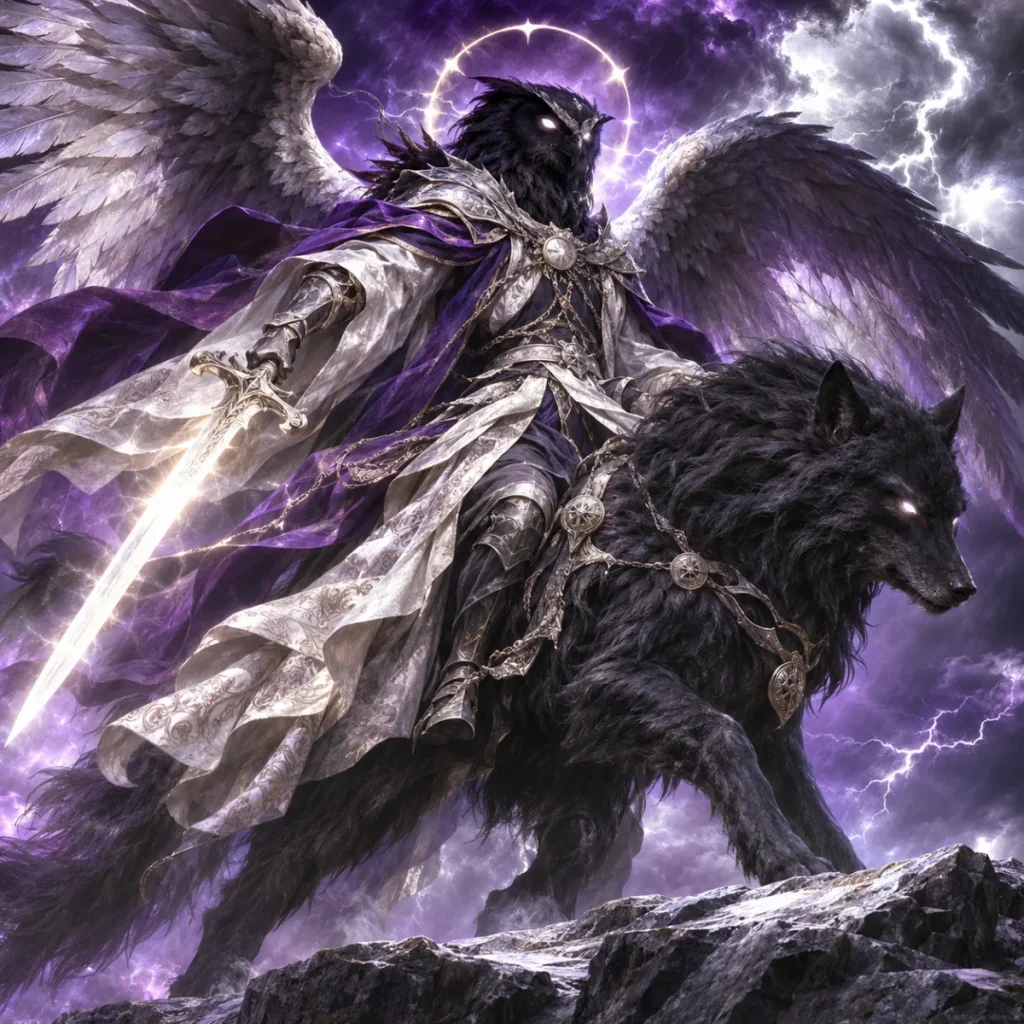
An angel’s body, the head of a night bird, a black wolf for a mount and a drawn sword. Andras, the 63rd spirit of the Ars Goetia, has one of the most unsettling images in the catalog, and an office to match: sowing discord.
He is also one of the few spirits whose entry includes a direct warning about the danger he poses to whoever deals with him.
Who is Andras in the Ars Goetia?
Joseph H. Peterson’s transcription of Sloane MS 3825 describes him as “a great Marquiz” in command of 30 legions of spirits. He holds place 63 among the 72 spirits of the Ars Goetia. His rank and legions are part of the grimoire’s internal hierarchy, the way a written tradition orders its spirits.
What does Andras look like?
The text presents him “in ye forme of an angell wth a head like a Black night Raven, ridding upon a black strong woolf, wth a sharpe bright sword flourishing in his hand.”
The expression “night raven” deserves attention. In Johann Weyer’s Latin, Andras’s head is compared to that of a black nycticorax, the same term used for the form of Stolas. Peterson notes, in connection with Stolas, that this “night raven” is not a raven at all but a heron, so called because it is nocturnal and its cry resembles a raven’s. That is why versions that give Andras an owl’s head do not follow the manuscript: there is no owl there.
What powers does the grimoire attribute to Andras?
According to Sloane 3825, his office is “to sow discords.” The warning follows at once: “if ye Exorcist hath not a care he will kill him and his fellows.”
The text teaches no techniques for killing and adds no further powers: only discord and risk. Like the rest of the catalog, this is a literary attribution, not a demonstrated power. What it does reveal is the grimoire’s logic, which imagines certain spirits as forces dangerous even to those who presume to command them.
Andras in Weyer: the threat without conditions
Andras appears in the Pseudomonarchia Daemonum (1577) as spirit 54, with the same name, the same rank of Marquis and the same 30 legions. The image matches: angelic form, the head of a black nycticorax, a black wolf and a very sharp sword.
The difference lies in the warning. Weyer sets no conditions: Andras, he says, knows how to kill the master, the servant and their helpers, and he is an author of discords. The Ars Goetia turns that statement into a conditional risk: the danger exists only “if ye Exorcist hath not a care.” It looks like a small change, but it turns a description into a practical precaution.
Peterson also records the variant Vandras in another catalog of spirits.
Andras’s seal
The manuscript specifies that his seal is to be made and worn as a lamen “before [thee] on you[r] Breast.” It is one of the few entries that says where to wear it. The grimoire’s general rules associate the seals of marquises with silver.
Why Andras still draws attention
Andras condenses several fears into one figure: the angel who no longer protects, the wolf as mount, the weapon at the ready and discord as a trade. A modern reader may see him as an image of conflict that turns against whoever stirs it up. The text doesn’t put it that way, but its warning points in that direction.
