
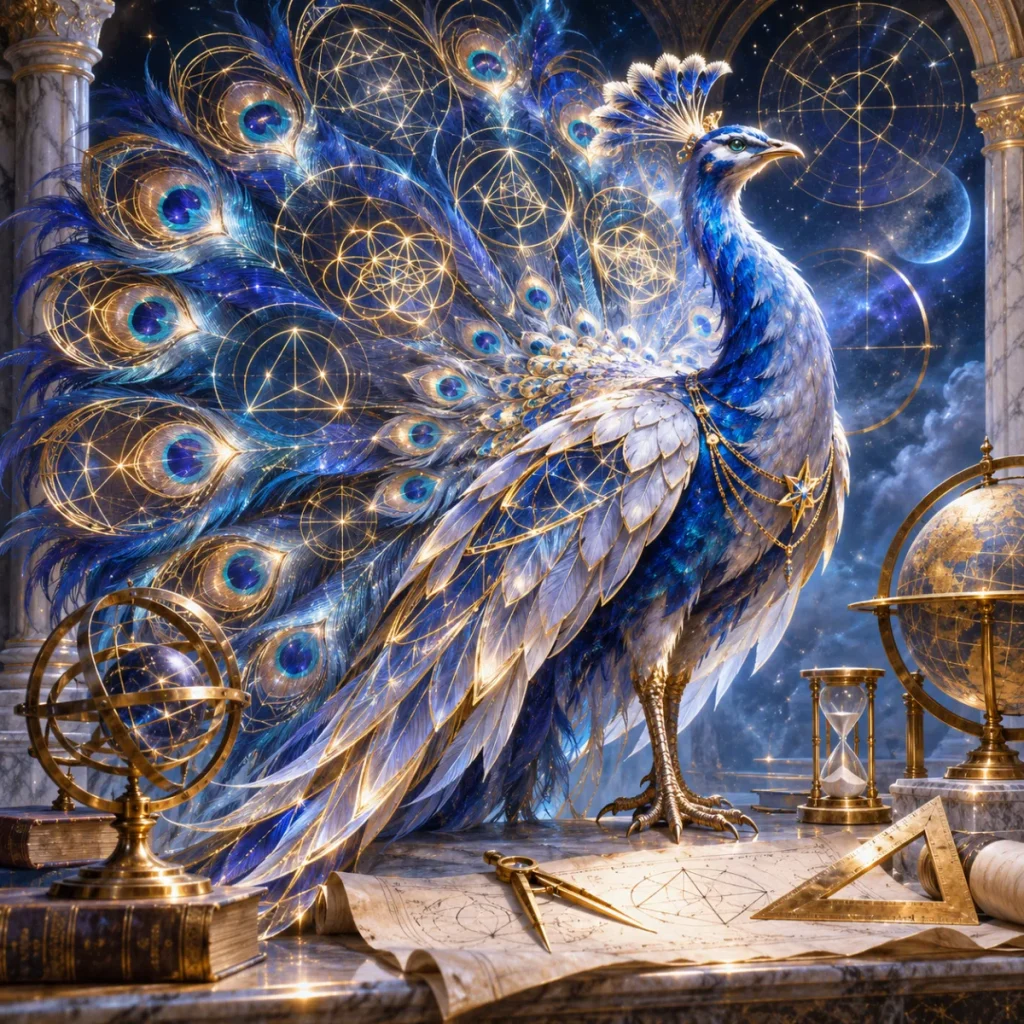
He arrives as a peacock amid great noises and ends up teaching geometry. Andrealphus, the 65th spirit of the Ars Goetia, pairs one of the showiest entrances in the catalog with one of its most sober offices: measurement, astronomy and subtlety of reasoning.
Who is Andrealphus in the Ars Goetia?
In Joseph H. Peterson’s transcription of Sloane MS 3825, Andrealphus is “a Mighty great Marquiz” in command of 30 legions of spirits. He holds place 65 among the 72 spirits of the Ars Goetia. His rank and legions, like the rest of the book’s hierarchy, belong to the grimoire’s own way of ordering its spirits.
What does Andrealphus look like?
According to Sloane 3825, he appears “at first in ye forme of [a] Peacock, with great Noises,” and afterwards takes human shape.
The sound detail is curious. Peterson glosses Weyer’s Latin (graves edit sonitus) as deep or heavy noises: not just loud, but low-pitched. Otherwise the peacock is the entire description; the text adds no colors, jewels or gestures.
What powers does the grimoire attribute to him?
The text says Andrealphus “can teach perfectly geomitry, & all Things belonging to measuring, also Astronomy,” and that “he maketh men very subtile and cunning therin.” Finally, he “can Transforme a Man into ye likness of a Bird.”
It is best not to stretch the list. Sloane 3825 says nothing of applied mathematics, sacred surveying or temporary transformations: it speaks of geometry, measurement and astronomy, and of a metamorphosis into a bird with no further details. These are, moreover, attributions of the grimoire, not demonstrated abilities.
The entry’s internal coherence is striking: a spirit who appears as a bird can turn others into birds. The grimoire doesn’t explain it, but the echo is plain.
Andrealphus in Weyer and other versions
In Johann Weyer’s Pseudomonarchia Daemonum (1577), the spirit is called Androalphus and holds number 55, with the same rank of Marquis and the same 30 legions. Reginald Scot’s English translation already spells the name Andrealphus, the form the Ars Goetia keeps.
There is a nuance in his powers. According to Weyer, in human form he makes a man sharp in argument and prudent in astronomy; Scot renders it as making him “a subtill disputer.” The Ars Goetia generalizes: he makes men subtle and cunning in the subjects he teaches. The skill in debate gets lost along the way.
Peterson records other spellings in manuscript catalogs, such as Andrielfis, Andriflis and Andralphus.
The seal of Andrealphus
The manuscript says his seal “is to be worne as a Lamin.” In the grimoire’s general rules, the seals of marquises are associated with silver. To reproduce it, the prudent course is to start from an identified manuscript witness rather than from redrawn versions.
What Andrealphus reveals
Andrealphus belongs to a group of spirits in the catalog who teach disciplines considered noble, alongside Stolas with astronomy or Furcas with philosophy. His own field is measurement: geometry and “all Things belonging to measuring.” That a figure as ostentatious as the peacock should teach so exact a discipline is one of the tensions that make the Ars Goetia memorable, though any symbolism found in it is the modern reader’s own.
