
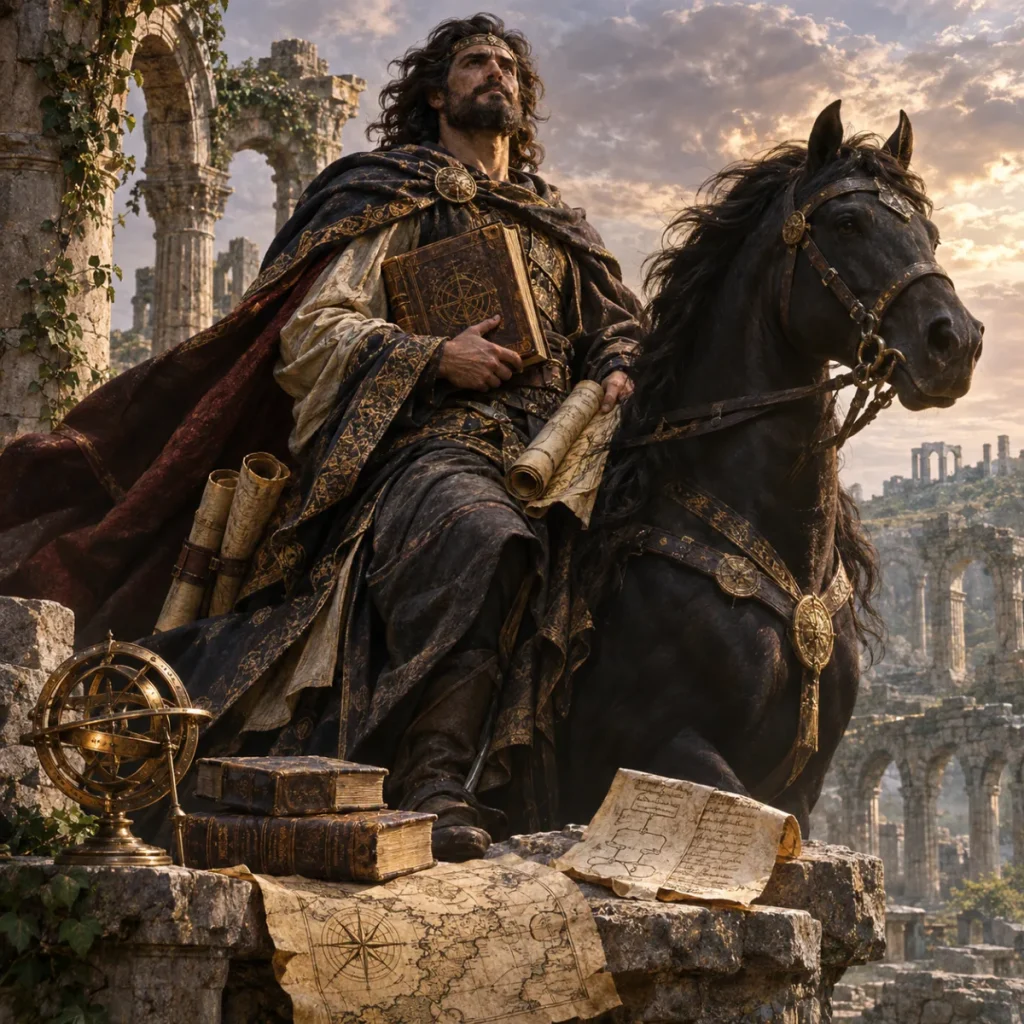
A valiant soldier on a fine black horse, lord of the spirits of Africa and master of grammar. Cimejes, the 66th spirit of the Ars Goetia, combines a warrior’s image with a classroom office like few others: teaching the three arts of language.
His name is spelled several ways. Sloane MS 3825 reads Cimeies; Johann Weyer, Cimeries. The spelling Cimejes, common in modern lists, is probably the same word, with the long i of old handwriting read as a j.
Who is Cimejes in the Ars Goetia?
In Joseph H. Peterson’s transcription, Cimeies is “a mighty great Marquiz strong & powerfull.” He governs “20 Legions of cheefe spirits, but more Inferior then himself.” He holds place 66 among the 72 spirits of the Ars Goetia.
The text adds something unusual for the catalog: a geographic domain. Cimejes “ruleth over all spirits in ye part[s] of Africa.”
What does Cimejes look like?
According to Sloane 3825, he appears “like a valiant souldier, riding on a goodly Black horse.” There is no later transformation and no further detail: no specific weapons, no face.
What powers does the grimoire attribute to Cimejes?
His office is “to Teach perfectly grammar Rhetoric [&] logick and to discover Treasures & Things lost or hidden.” He can also “make a man seeme like a souldier of his own likness.”
Grammar, rhetoric and logic made up the trivium, the foundation of an education in the liberal arts. Placing that knowledge in the hands of an armed horseman is one of the grimoire’s most striking contrasts. All of it, it’s worth remembering, belongs to the text’s attributions, not to demonstrated abilities.
Cimeries in Weyer: the soldier who wasn’t there
In the Pseudomonarchia Daemonum (1577), the spirit is called Cimeries and holds number 60, with the same rank of Marquis and the same 20 legions. There too he rules “in the parts of Aphrica,” teaches grammar, logic and rhetoric, and discovers treasures and hidden things.
But Weyer does not describe him as a soldier: he only says that he rides a great black horse. The soldier appears in another power, that of making a man seem to be swiftly turned into a soldier. The Ars Goetia transfers that image to the spirit’s own appearance and turns the transformation into making a man a soldier “of his own likness.”
Peterson points out another small difference: Sloane 3825 writes “part” of Africa, in the singular, while Weyer, Scot and other manuscripts say “parts.” He also records the variant Tvueries in a manuscript catalog.
The seal of Cimejes
The manuscript says his seal is to be made and worn as a lamen. In the grimoire’s general rules, the seals of marquises are associated with silver. For a rigorous reproduction, start from an identified manuscript witness.
Why Cimejes matters
Cimejes shares with Furcas, another horseman in the catalog, the teaching of rhetoric and logic. But his most singular trait is Africa, one of the catalog’s rare geographic references. For a European reader of the period, placing a spirit in distant lands heightened its aura of power and mystery; that is our reading, but it helps explain why the detail survived from Weyer into the Ars Goetia.
