
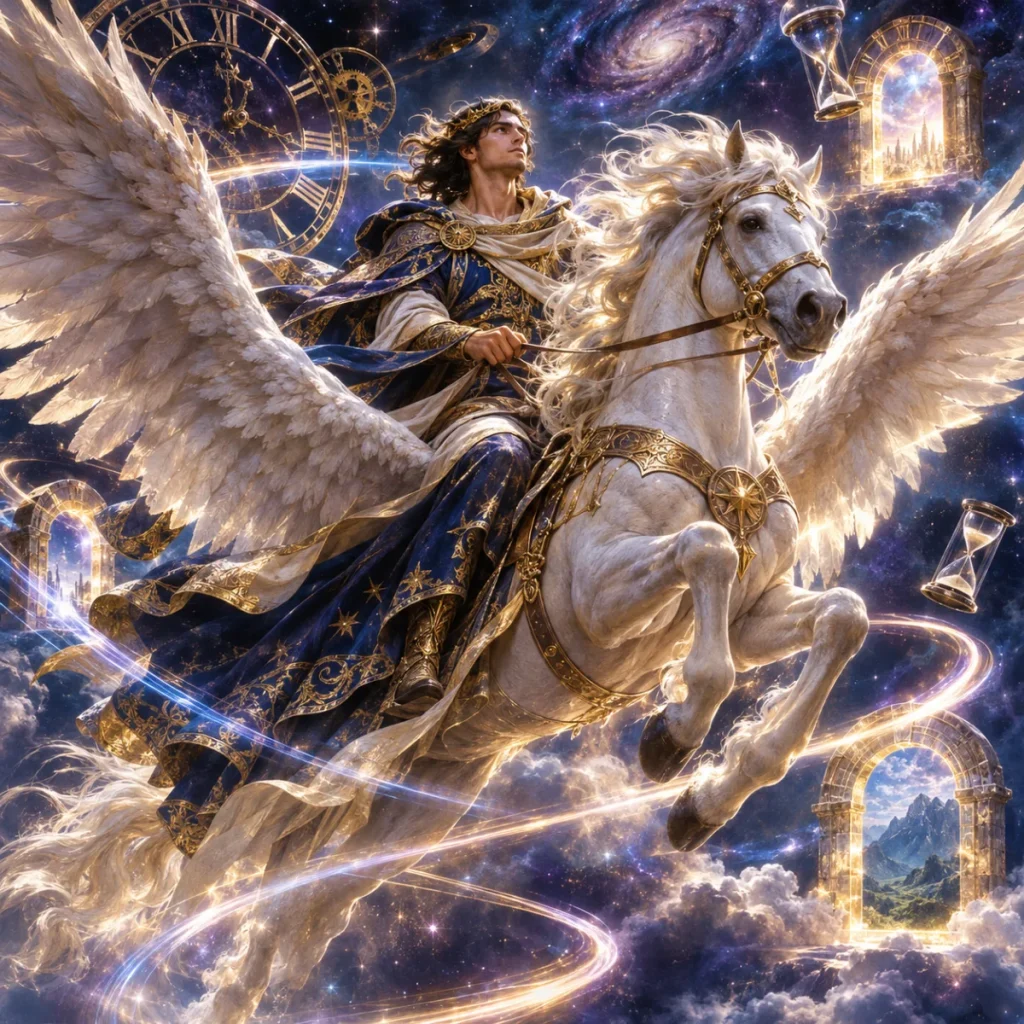
A beautiful man on a winged horse, able to cross the whole world in the twinkling of an eye. Seere, the 70th spirit of the Ars Goetia, is speed turned into a character. And he has one peculiarity that sets him apart from almost all his neighbors: he does not appear in Johann Weyer’s catalog.
Who is Seere in the Ars Goetia?
In Joseph H. Peterson’s transcription of Sloane MS 3825, Seere is “a Mighty Prince and powerfull under Amaymon, king of ye East.” He governs 26 legions of spirits and holds place 70 among the 72 spirits of the Ars Goetia.
His is one of the few entries that name a superior. Amaymon is one of the four kings of the cardinal points that the Ars Goetia mentions at the end of its catalog. Peterson observes that in other sources, such as the Folger manuscript, Amaymon appears as king of the South, not the East.
Peterson also records the forms Seer, Sear and Seir in other copies.
What does Seere look like?
The text presents him “in ye forme of a Beautifull Man, riding on a strong horse wth wings.” There is no earlier animal form and no transformation: Seere appears directly in human shape, just like the two spirits that close the catalog.
What powers does the grimoire attribute to Seere?
His office is “to goe & come, and to bring all Things to pass on a sudden & to carry & recarry any Thing where Thou wilt have it,” for he can pass over the whole world “in ye Twinckling of an Eye.” He also gives a true account of all sorts of theft, of hidden treasure and of other things.
The text adds a trait of character: he is “Indifferent good Natured, willing to do any thing ye Exorcist desireth.” The manuscript has no fugitives and no goods “brought back on the spot,” as some summaries claim. And, like the whole catalog, these are attributions of the grimoire, not demonstrated abilities.
Seere, absent from Weyer
Seere appears neither in Weyer’s Pseudomonarchia Daemonum (1577) nor in Reginald Scot’s English translation. Neither do Dantalion and Andromalius, the two spirits that close the catalog. Weyer lists 69 spirits; the Ars Goetia leaves out one of them (Pruflas) and adds four, Vassago, Seere, Dantalion and Andromalius, to reach 72.
Where did Seere come from? Peterson suggests he was possibly drawn from Sloane MS 3824, which contains a passage titled “Of the spirit Seere.” There he is said to be under the King of the East; he “goes & comes & brings all things to suddaine and expeditious effects,” can pass over the whole world “in a moment, yea in the twinkling of an Eye,” and is “by nature indifferent good, mild courteous and affable.” The Ars Goetia entry is almost a summary of that text.
Seere’s seal
The manuscript calls it his “Mark or seal” and says it is to be worn as a lamen. The grimoire’s rules do not mention princes when assigning metals; Peterson assumes that the “prelates” on that list, associated with tin, are their equivalent.
Why Seere matters
Seere is proof that the Ars Goetia is not a simple copy of Weyer: its compilers filled out the number 72 with material from other manuscripts. His friendly, swift figure, who fetches everything and reports everything, contrasts with the catalog’s menacing spirits. A modern reader might see him as the fantasy of the perfect messenger; the text, at least, paints him as one of the most obliging spirits in the book.
