
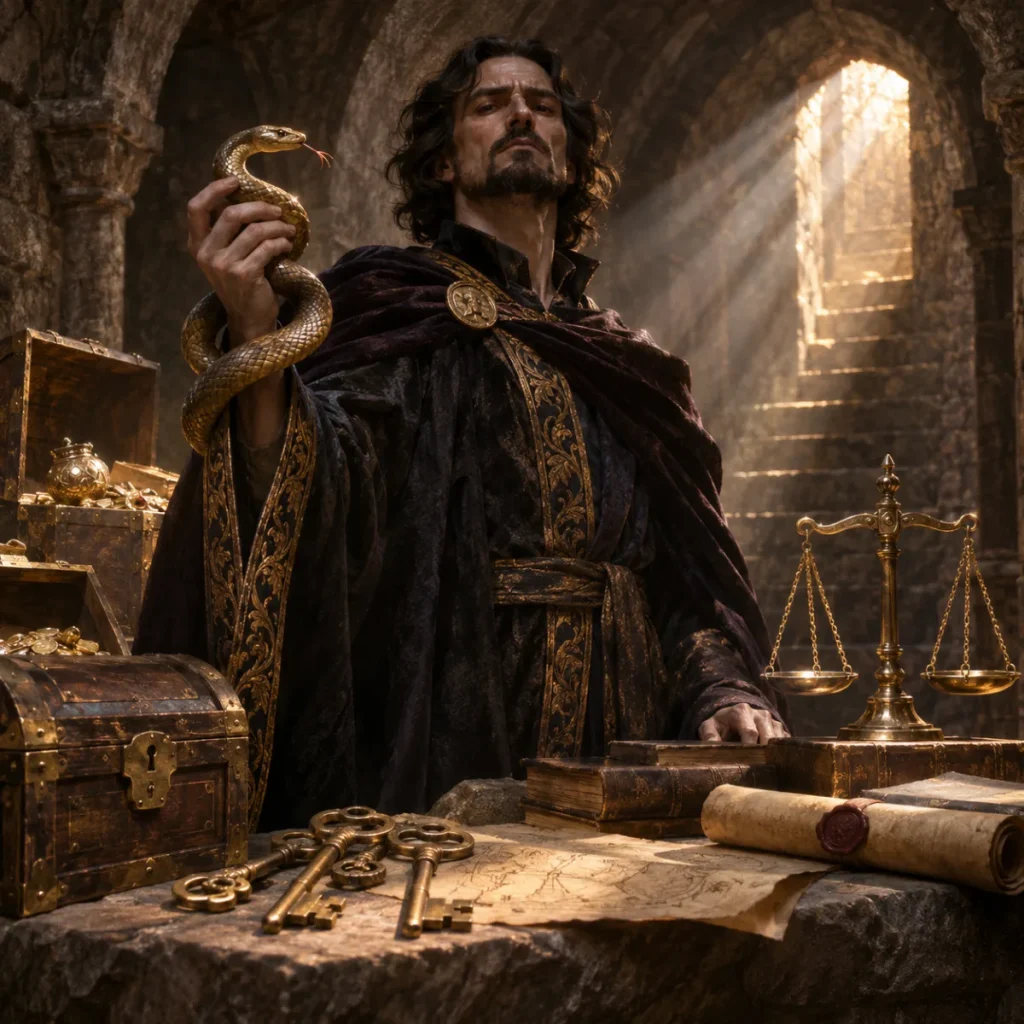
The catalog of the 72 spirits ends with a detective. Andromalius, the 72nd spirit of the Ars Goetia, appears as a man with a serpent in his hand, and his office is to recover what was stolen, bring the thief back and drag shady dealings into the light.
He is also one of the spirits missing from Johann Weyer’s catalog, and his name circulated in stand-alone spells for catching thieves.
Who is Andromalius in the Ars Goetia?
In Joseph H. Peterson’s transcription of Sloane MS 3825, Andromalius is “a great and Mighty Earle” who rules 36 legions of spirits. He holds the very last place among the 72 spirits of the Ars Goetia. His rank and legions, as throughout the catalog, belong to the grimoire’s own hierarchy.
What does Andromalius look like?
The text is brief: he appears “in ye form of a Man, holding a serpent in his hand.” Nothing more.
Sloane 3825 has no gigantic serpent, no man strangling it, and none of the other dramatic details found in some modern descriptions. The manuscript does not explain the meaning of the serpent; any symbolism is later interpretation.
What powers does the grimoire attribute to Andromalius?
According to Sloane 3825, his office is “to bring a Theefe & goods yt are stolen, Back,” to discover all wickedness and underhand dealings, “to punish Theives & other wicked people,” and to discover “Treasure that is hidd.”
There is a small textual correction here. The Sloane 3825 copyist wrote “understand dealings,” which makes little sense; Peterson emends it to “underhand dealings,” the reading of other manuscripts. Like the rest of the catalog, all of this belongs to the realm of the grimoire’s attributions, not of demonstrated abilities.
Andromalius outside Weyer: the thieves’ spirit
Andromalius appears neither in Weyer’s Pseudomonarchia Daemonum (1577) nor in Reginald Scot’s English translation. Peterson notes, however, that he is common in stand-alone spells in magical manuscripts, where he is employed to detect a thief or discover treasure.
In those texts his name is usually spelled Andromalcus, with many variants: Andromalce, Andromalcum, Andrewemalcus or Andrea Malchus. The Ars Goetia settles on the form Andromalius.
Peterson also cites a passage from Sloane MS 3824, titled “Of the spirit Andromalius,” which expands the list: he discovers “all manner of secrets,” underhand dealings, plots, contrivances and “all deceiptfull designes” aimed at someone’s ruin; he punishes “all manner of lewd, theivish, deceitfull, ungodly persons”; and he “faithfully declareth the verity of treasure trove.” The Ars Goetia entry reads like a condensed version of that text. Like Seere and Dantalion, he helps complete the count of 72.
The seal of Andromalius
The manuscript says his seal is to be made and worn as a lamen “in time of acction,” that is, during the operation. In the grimoire’s general rules, the seals of earls are made of copper and silver in equal parts.
What Andromalius reveals
That the catalog ends with a spirit devoted to recovering stolen goods says a lot about the everyday worries surrounding these texts: theft, distrust, hidden treasure. Andromalius promises neither glory nor universal wisdom, but practical justice. He is the least grandiose figure at the close, and perhaps for that reason one of the most revealing.
