
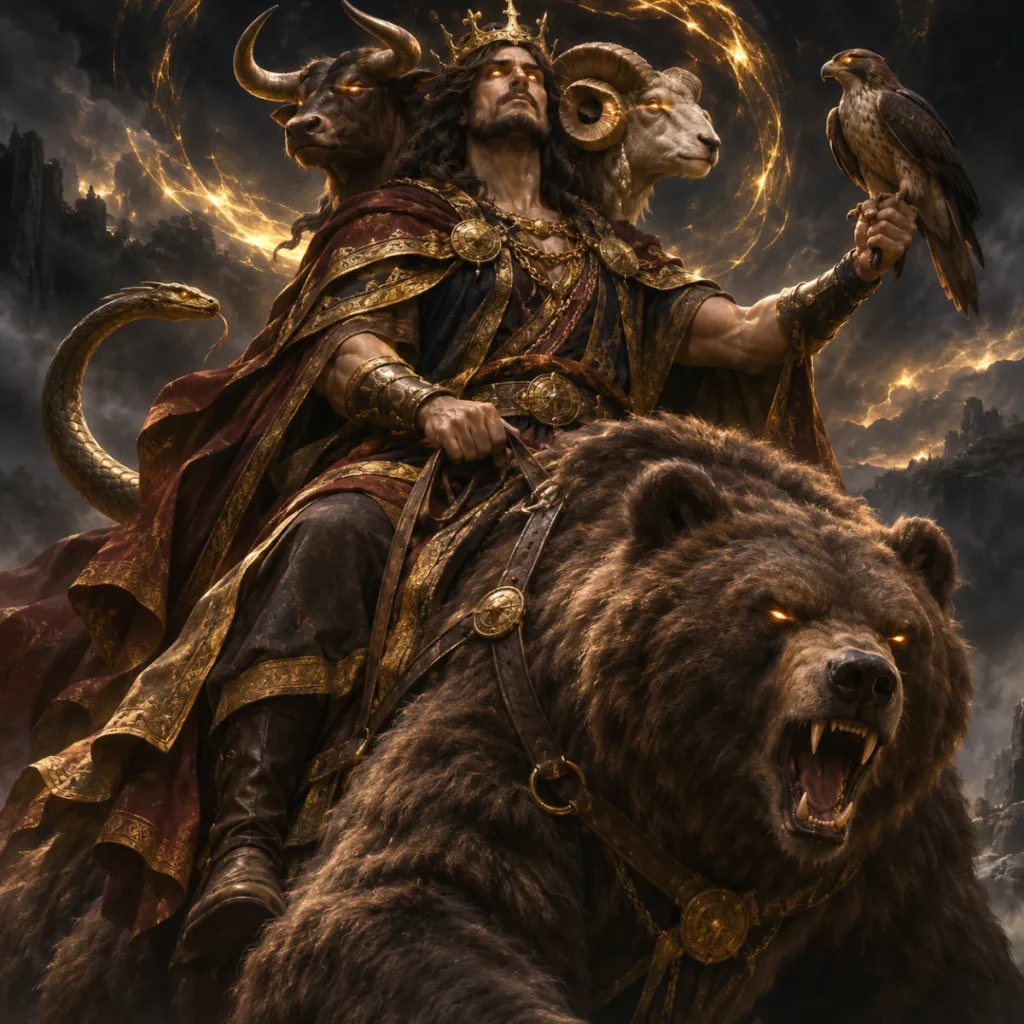
The head of a bull, the head of a man and the head of a ram; a serpent’s tail, flaming eyes, a furious bear for a mount and a goshawk on his fist. Balam may be the most elaborate figure in the Ars Goetia, and the text itself doesn’t hold back on adjectives: it calls him “Terrable.”
Who is Balam in the Ars Goetia?
Balam is spirit number 51 of the 72 spirits of the Ars Goetia. In Joseph H. Peterson’s transcription of Sloane MS 3825 he appears as “a Terrable, great & powerfull king” with 40 legions under his command. That makes him one of the few kings in the catalog.
What does Balam look like?
The text lists his features without pausing for breath: he appears “wth 3 heads, The first is like a Bulls, The second like a Mans, & ye Third like a Rams head he hath a serpents Taile, & Eyes flaming.” He rides “upon a furious Beare,” carries “a gosh hawke on his fist,” the bird of falconry, and “speaketh wth a hoarse voyce.”
Unlike many spirits, he is not said to take human form afterward: the composite figure is his manifestation. And here the three heads are literal in the text, not an artistic reading.
What powers does the grimoire attribute to him?
Balam gives “True answares of Things past present & to come,” and “maketh men to goe invisible & witty.” Invisibility links him to Bael, the first king of the catalog, who has the same power. These attributions belong to the grimoire’s story and have no standing as fact.
Balam in Weyer and other manuscripts
In Johann Weyer’s Pseudomonarchia Daemonum (1577) he is number 63. The Weyer text Peterson transcribes abbreviates the name as “Balã,” and the 1660 edition of the collected works spells it out as Balam. The description matches point by point: three heads, serpent’s tail, fiery eyes, bear, bird of prey, hoarse voice, prophecy, invisibility, wisdom and 40 legions.
Weyer adds a detail that Sloane 3825 does not keep: Balam “was of the order of dominations,” one of the angelic choirs. Peterson also notes that in the Folger manuscript (the so-called Book of Oberon) he appears under the name Bason, as King of the West.
Is Balam related to the biblical Balaam?
The resemblance to Balaam, the prophet of the Book of Numbers, is obvious. But neither the Ars Goetia nor Weyer makes that connection, and the entry contains no element of the biblical story: no talking donkey, no blessing of Israel. It is a coincidence of names, not a proven kinship.
Balam’s seal and what he reveals
The text includes his seal, to be made and worn as a lamen. As for meaning, Balam shows how far the catalog’s compositional imagination could go: farm animals, a wild beast and a hunting bird combined into a single royal figure. Rather than describing a creature, the entry piles up symbols of strength, dominion and the hunt.
