
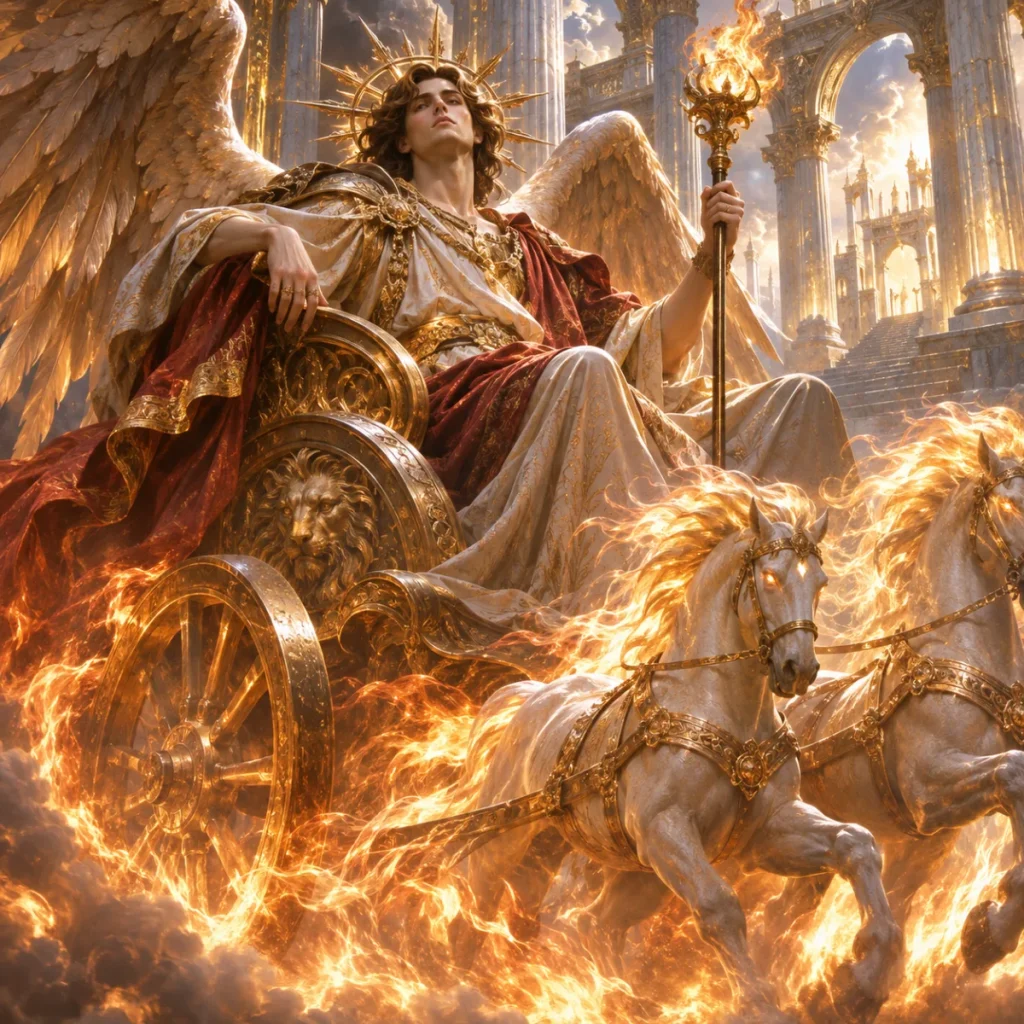
A beautiful angel seated in a chariot of fire, speaking with a pleasing voice and boasting that he fell before anyone else. Belial, the 68th spirit of the Ars Goetia, is much more than a catalog entry: he is the figure who closes the story of how Solomon shut the 72 spirits in a vessel, and how they got out.
Who is Belial in the Ars Goetia?
In Joseph H. Peterson’s transcription of Sloane MS 3825, Belial is “a mighty king and powerfull” in command of 80 legions of spirits. The text states that “he was Created next after Lucifer, & is of his order.” He holds place 68 among the 72 spirits of the Ars Goetia.
The name comes from the Hebrew Bible, where beliyyaal is usually understood as “worthlessness” or “wickedness.” The grimoire, however, does not explain it and treats it as just another proper name.
What does Belial look like?
Sloane 3825 presents him “in ye forme of a Beautiful angel sitting in a Charriot of fire, speaking wth a comly voice.” The angel is singular. Some modern versions put “two angels” in the chariot; that reading appears neither in Sloane 3825 nor in Weyer.
On appearing, he declares “that he fell first & amongst ye worthier & wiser sort wch went before Michael & other heavenly angels.” It is one of the few entries in which the spirit tells his own story.
What powers does the grimoire attribute to Belial?
Belial distributes “preferments of senatorships,” causes the favor of friends and foes, and gives excellent familiars. But the text sets a condition: the exorcist must present him with “offerings sacrafices & gifts,” or he will not give true answers. And even then, it adds, “he Tarryeth not one hour in ye truth except he be constrained by devine power.”
All of this belongs to the grimoire’s world, not to demonstrated abilities. What stands out is the portrait: a spirit who hands out honors and, at the same time, cannot be trusted.
Belial in Weyer: “some say”
In Johann Weyer’s Pseudomonarchia Daemonum (1577), Belial is spirit 23, also a King and also with 80 legions, which Weyer divides between the order of Virtues and that of Angels. There is an important shift in tone: Weyer presents his creation after Lucifer as something “some saie,” and adds that for this reason they consider him the father and seducer of those who fell. The Ars Goetia states it without qualification.
Weyer’s entry also contains the story of the imprisonment: Solomon gathered the 72 kings with their legions in a vessel and cast them into “a deepe lake or hole in Babylon.” In Weyer’s list, the first was Bileth, the second Belial and the third Asmoday. Peterson notes that the Latin calls it a vessel of glass, though Scot’s translation says “brasen.” The mention of 72 kings is curious, because Weyer’s own catalog contains only 69 spirits.
Belial’s seal
The manuscript says his seal “is to be worne as a Lamin, before ye Exorcist.” In the grimoire’s general rules, the seals of kings are associated with gold.
Why Belial closes the Ars Goetia
The Ars Goetia moves that story to the end of its catalog. There, the chief spirits shut away are Belial, Beleth (Bileth), Asmoday and Gaap, and “it is supposed it was for their pride.” The Babylonians, “suspecting to find a great Treasure,” broke the vessel open; the spirits returned to their former places, all but Belial, who “entered Into a certaine Image” and gave answers to those who offered him sacrifice.
That ending explains his weight in the book. Belial is not just one of the 72 but the only one who, according to the story, went on receiving worship after the escape. His entry and the catalog’s close draw the same figure: a splendid fallen angel, demanding and unreliable. Peterson also records him in the Folger manuscript, as Beliall, and among the spirits mentioned by Trithemius in his Polygraphia.
