
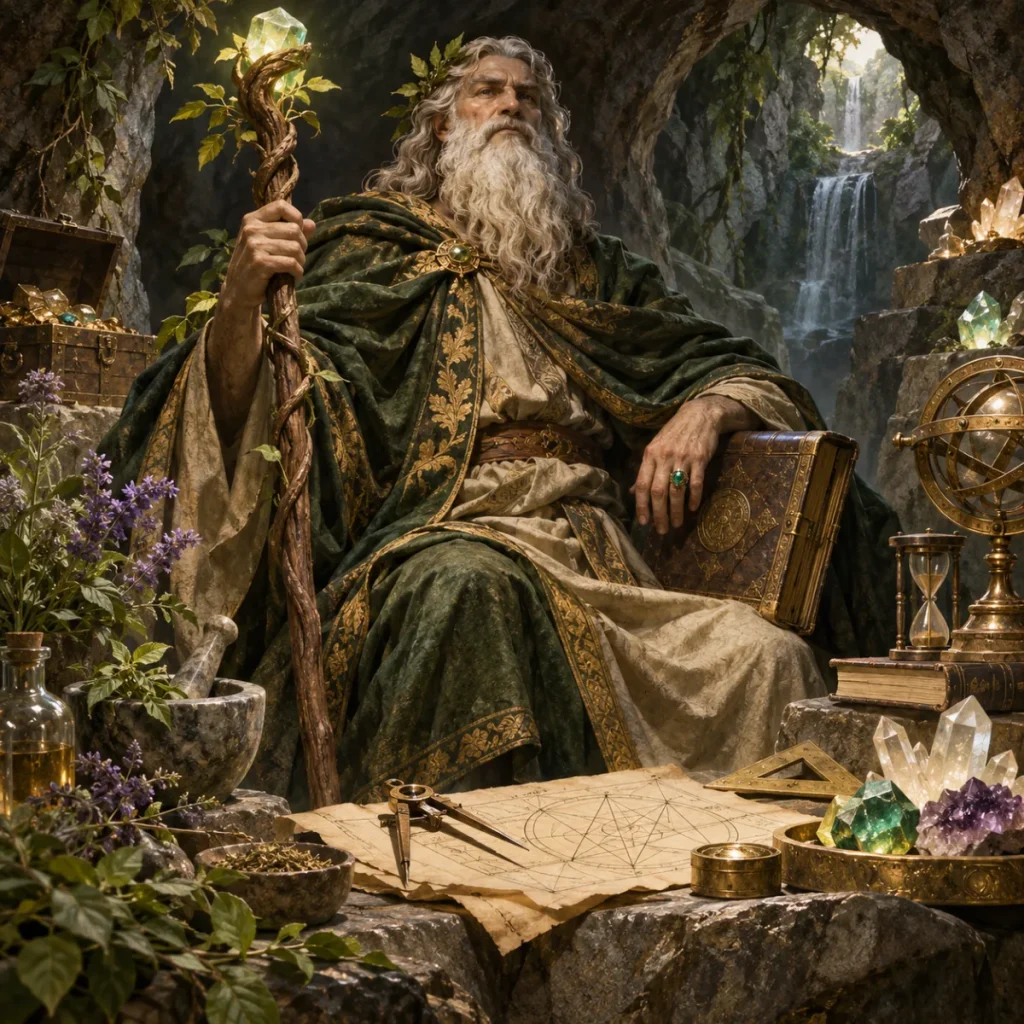
Herbs, precious stones, logic and ethics: Foras, the 31st spirit of the Ars Goetia, has the profile of a teacher rather than a monster. No wings, no fire, no beasts. The grimoire pictures him simply as a strong man.
Who is Foras in the Ars Goetia?
In Joseph H. Peterson’s transcription of Sloane MS 3825, Foras is “a mighty great president” who rules over 29 legions of spirits. The text gives him no angelic choir of origin and no story of a fall. The entry focuses on his appearance and, above all, on what he teaches.
What does Foras look like?
He appears “in ye form of a strong man, in humane shape.” It is one of the plainest descriptions among the 72 spirits of the Ars Goetia. There are no weapons, mounts, crowns or animal features, and no later transformation either: Foras shows up human from the start.
Any image that dresses him as a sage, a warrior or a bearded old man is a free interpretation. The manuscript stresses only his strength.
What powers does the grimoire attribute to Foras?
His repertoire is broad and largely intellectual. According to the text, he gives men the understanding of how “they may know ye vertues of all hearbs and precious stones,” and teaches “ye art [of] Logick & Ethicks in All their partes.” He also “maketh men Invisible, witty, Eloquent & to live Long,” discovers treasures and recovers things lost.
All of this belongs to the grimoire’s world of attributions, not to proven abilities. What makes it interesting is the mix. Subjects straight out of the schoolroom, like logic and ethics, sit side by side with the classic promises of magical literature, like invisibility and hidden treasure. His knowledge of herbs and stones brings him close to Stolas, who teaches the virtues of both in the same list.
Foras, Forras or Forcas: his name in Weyer
Foras comes from Johann Weyer’s Pseudomonarchia Daemonum (1577), where he is entry 29 under the name “Forras vel Forcas.” Reginald Scot’s English translation calls him “Foras, alias Forcas,” and that is where the Lemegeton form comes from. Peterson also notes that the Folger manuscript records the forms Forcase, with the rank of prince, and Partas.
The content matches almost point for point: a very strong man, the virtues of herbs and stones, logic and ethics, invisibility, wit, eloquence, long life, treasures, lost objects and 29 legions. In this case there are no discrepancies of rank or number.
The alias Forcas invites confusion with Furcas, the 50th spirit, who also teaches logic among other arts. They are, however, separate entries in both Weyer and the Ars Goetia. Furcas is a Knight who appears as a cruel old man on a pale horse; Foras is a President in human form with no further attributes.
The seal of Foras and what he reveals
The manuscript speaks of his “seale or Character” and presents it to be “worne as a Lamen.” If you reproduce it, the most reliable starting point is an identifiable documentary edition, not a redrawn copy.
Beyond the seal, Foras is a fine example of how the grimoire recycles the ideal of learning of its time: the logic and ethics of the schools, the knowledge found in herbals and lapidaries, and the very human wish to live longer and find what was lost. A whole period’s library fits into a single figure, seen through the mirror of magic.
