
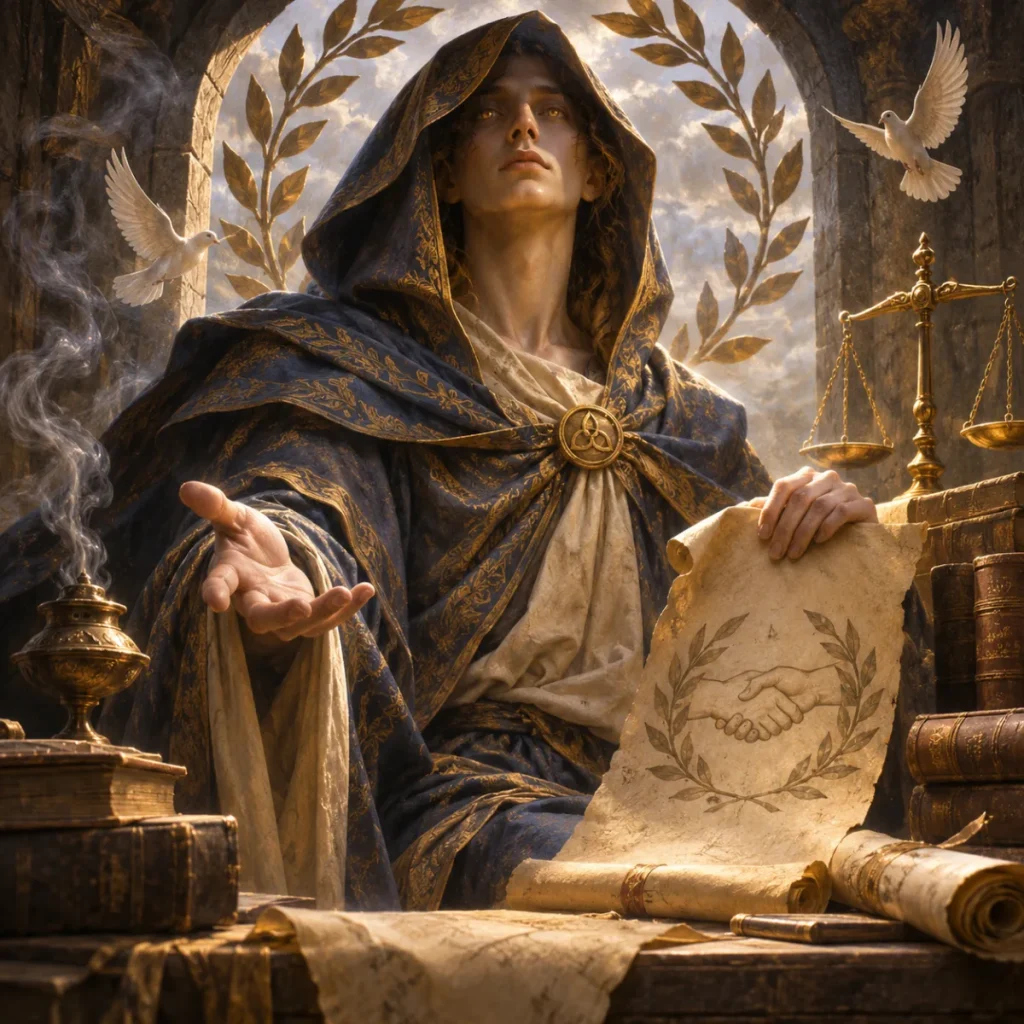
He answers any question, knows the past, present and future, reconciles friends and hands out honors. Gusion, the eleventh spirit of the Ars Goetia, has clear-cut powers. What no one has fully worked out is his appearance: the manuscript says he appears as a “Xenophilus,” a word even his translators did not understand.
Who is Gusion in the Ars Goetia?
In Joseph H. Peterson’s transcription of Sloane MS 3825, the spirit is called Gusoin, not Gusion. He is “a great & strong duke” who rules over 40 legions of spirits. The spelling “Gusion,” the most common today, does not appear in Peterson’s transcription; Johann Weyer writes Gusoyn, and other copies Peterson records call him Cason or Gazon.
What does Gusion look like?
The text says only that he “appeareth like a Xenophilus,” with a bracketed correction, zenophali, taken from Weyer. Neither form describes a recognizable figure.
Peterson suggests, with a question mark, that it may be a corruption of zenocephalus, “dog-headed,” along the lines of the Greek term cynocephalus. A Latin manuscript in Munich (CLM 849) reads senaphali, which confirms that the word was already garbled in the early copies. So any illustration of Gusion with a dog’s head, or with any other specific form, rests on a conjecture, not on a reliable description.
What powers does the grimoire attribute to Gusion?
According to the Ars Goetia, Gusion:
- “telleth of all things past, present & to come”;
- “sheweth ye meaning of all questions you can ask”;
- “reconcileth friends”;
- “giveth honour and dignity to any.”
These are attributions of the grimoire, not testable abilities. His profile is that of a counselor: someone who interprets, clarifies and mediates. He shares knowledge of past and future with other spirits in this first part of the catalog, such as Amon and Barbatos.
Gusion in Weyer: five lost legions
In the Pseudomonarchia Daemonum (1577), Gusoyn holds eighth place. Weyer describes him as a great and strong duke who appears in forma zenophali and answers “explicitly and truly” about things present, past, future and hidden (occultis). He wins the favor of friends and enemies, confers dignities and confirms honors.
The most concrete difference is in the numbers. Weyer gives him quadragintaquinque legionibus, 45 legions. Reginald Scot’s English translation kept only “fourtie,” and the Ars Goetia inherited that figure. It is a small example of how a slip in translation becomes fixed in a tradition.
Peterson also finds the name in other spirit catalogs: Cason in the Munich manuscript mentioned above and Gazon in a copy at Trinity College, Cambridge.
Gusion’s seal
The manuscript presents his seal with the instruction to wear it “as aforesaid.” Like the other seals in the catalog, it does not come from Weyer.
Why Gusion matters
Gusion is a rare case: a much-cited spirit whose exact form we don’t know. His entry is a reminder that the Ars Goetia reached us through imperfect copies, with words nobody understood anymore and numbers lost along the way. Reading him alongside Weyer is the best way to tell what the text says from what was attributed to it later. The Ars Goetia index gathers the rest of the 72 spirits.
