
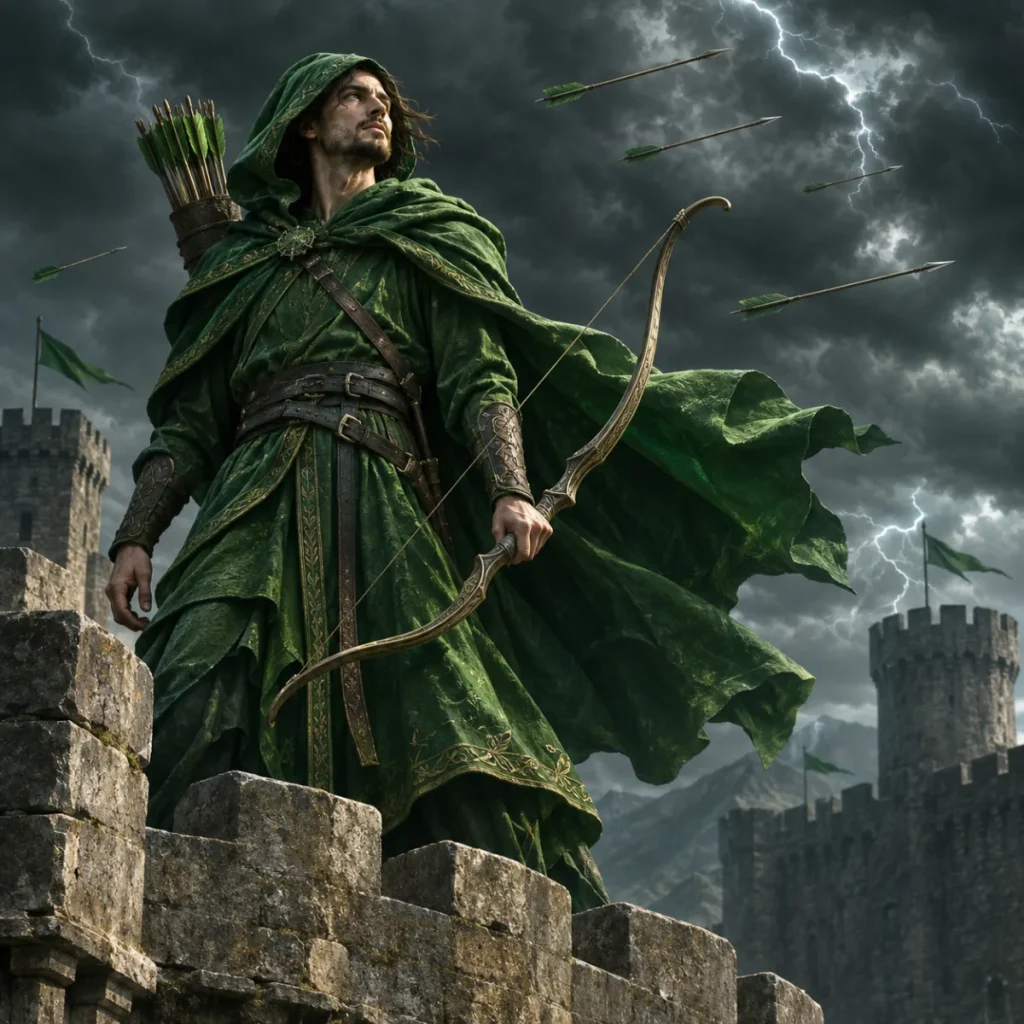
An archer dressed in green, with bow and quiver. The image of Leraje, the fourteenth spirit of the Ars Goetia, seems lifted from a forest ballad. His powers, by contrast, are grim: he stirs up battles and makes arrow wounds fester.
The green clothing that identifies him today is precisely what his oldest source lacks.
Who is Leraje in the Ars Goetia?
In Joseph H. Peterson’s transcription of Sloane MS 3825, the spirit is called Leraye, and above the line someone added “(or Leraje).” That interlinear variant is the form most often used today. The text presents him as “a Marquize great in power” who governs 30 legions of spirits.
What does Leraje look like?
According to the manuscript, he shows himself “in ye likeness of an archer, cladd in green carring a Bow and quiver.” It is one of the simplest and most human descriptions in the catalog: no animal features, no transformations, just an armed bowman.
At the end of the entry, the text includes a phrase that the manuscript completes with an astrological symbol: “this belongeth to Sagittarius.” The link with the archer’s sign is therefore part of the text itself, not a modern interpretation.
What powers does the grimoire attribute to Leraje?
According to the Ars Goetia, Leraje:
- “causeth all great Battles & contests”;
- “causeth ye wounds to putrifie that are made with arrows by archers.”
These are attributions of a magical text, not testable abilities. The second has a very concrete background: in premodern warfare, an infected wound could be deadlier than the blow itself. The spirit thus condenses a real fear of the battlefield.
Leraje in Weyer: Loray, alias Oray
In Johann Weyer’s Pseudomonarchia Daemonum (1577), the spirit is number 13 under another name: “Loray, alias Oray.” Reginald Scot’s English translation spelled it “Leraie alias Oray,” a form Peterson considers faulty and which already looks very much like the one in the Ars Goetia. Another copy Peterson records calls him Vorax.
Weyer describes him as a great marquis who appears in the form of a most handsome archer carrying a quiver and bow (Scot: “a galant archer”). He says nothing about the color green: that detail belongs to the Ars Goetia. Weyer makes him the author of all battles and has him putrefy the wounds dealt by archers. He adds an obscure phrase, quos optimos obijcit tribus diebus, which Scot left in Latin and Peterson translates as “which he shoots best within three days”; the Ars Goetia drops it. The 30 legions match.
Leraje’s seal
The manuscript presents a “seale of obediance,” the same formula it uses in other entries. It is not in Weyer, who includes no seals.
Leraje and the catalog’s other archers
Leraje is not the only spirit linked to the archer or to Sagittarius. In Weyer, Barbatos appears as a woodland archer, and the Ars Goetia also ties Buer to that sign. Comparing these entries shows how the English tradition tended to read in astrological terms images that were simpler in Latin. You can follow those connections in the index of the 72 spirits of the Ars Goetia.
