
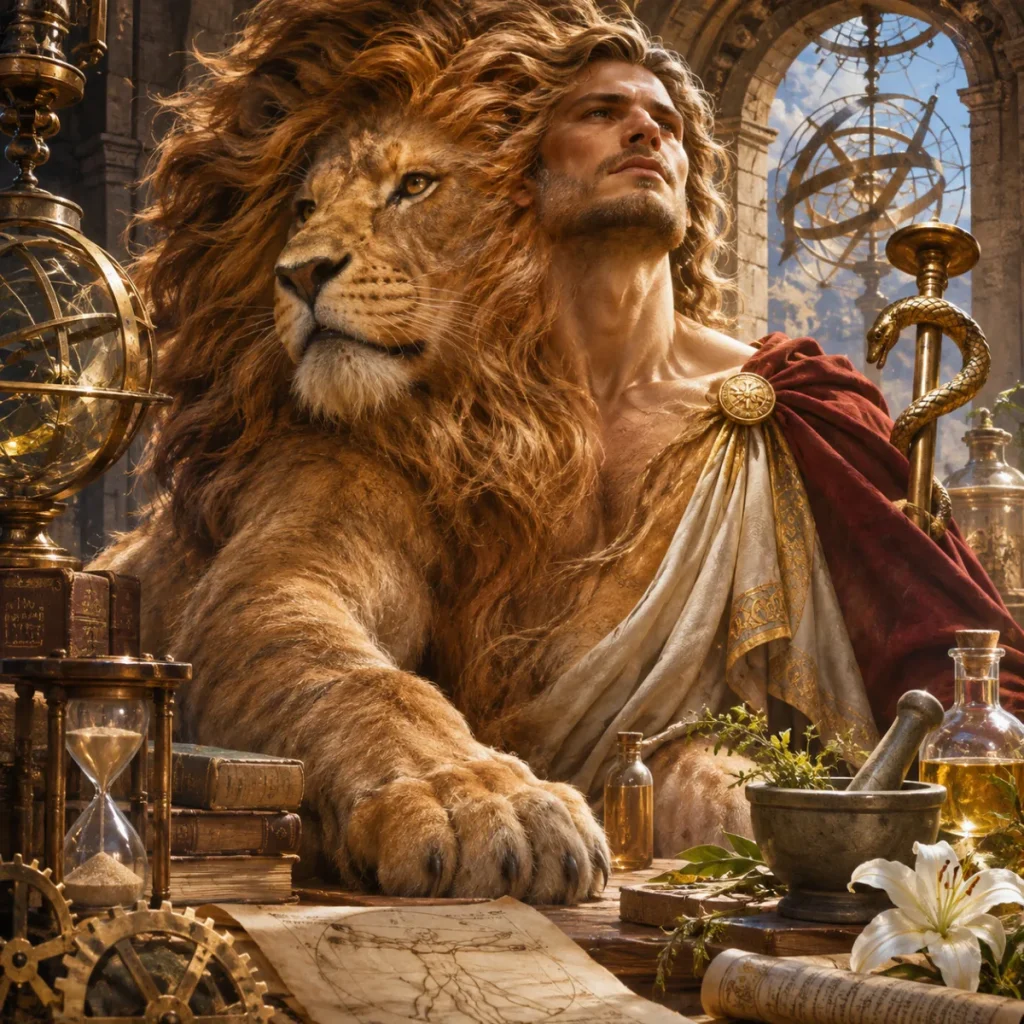
A great lion who, at the magician’s request, turns into a man. Marbas, the fifth spirit of the Ars Goetia, has one of the most contradictory lists of powers in the catalog: he causes diseases and cures them, reveals secrets and teaches practical trades.
Who is Marbas in the Ars Goetia?
In Joseph H. Peterson’s transcription of Sloane MS 3825, Marbas is “a great presedent” who governs 36 legions of spirits. President is one of the titles in the grimoire’s imaginary court, alongside kings, dukes, marquises, earls and princes; Peterson’s summary counts roughly a dozen presidents in the whole list.
Peterson adds that the Folger manuscript, known as the Book of Oberon, places Marbas in the East under King Oriens, together with Bael, Agares and Amon.
What does Marbas look like?
The text is brief: he “appeareth at first in ye forme of a great Lyon: but afterwards putteth on humane shape at ye Request of ye Master.” There are no further details about his mane, his voice or his clothing.
The lion is a frequent figure in the catalog. Valefar, the next spirit, is also a lion, though with a man’s head. With Marbas, by contrast, the animal form is complete and is set aside for a human one, a pattern repeated in many entries: the spirit first shows itself in a fearsome shape and then takes on a more approachable one.
What powers does the grimoire attribute to Marbas?
According to the Ars Goetia, Marbas:
- “Answareth truly of Things hidden or secreet”;
- “causeth deseases and cureth them againe”;
- gives “great wisdome & knowledge in mechanicall arts”;
- “changeth men into other shapes.”
These are attributions of magical literature, not proven powers. Even so, they say a lot. The “mechanical arts” were the manual and technical trades, as opposed to the liberal arts; the English translation of Weyer glosses them as “handicrafts.” A spirit who teaches carpentry or mechanics alongside medicine shows how wide a range of wishes the catalog set out to satisfy.
Marbas in Weyer: alias Barbas
Marbas holds third place in Johann Weyer’s Pseudomonarchia Daemonum (1577), under the name “Marbas, alias Barbas.” The description is almost identical: a great president who shows himself as a very strong lion (fortissimi leonis) and, when summoned by the exorcist, takes human form. He answers fully about hidden things, brings and removes diseases, promotes wisdom and knowledge of the mechanical arts, and transforms men. The 36 legions match.
The alias Barbas had a long life. Peterson records variants such as Barbarius in a fifteenth-century manuscript and “Barbas alias Corbas” in the Folger manuscript. The move from Weyer to the Ars Goetia also shifted his position, from third place to fifth.
The seal of Marbas
The manuscript introduces Marbas’s seal with the usual formula: “his seal is this.” Like the other seals of the Ars Goetia, it does not come from Weyer, who includes none, and anyone reproducing it should start from an identified manuscript copy.
What Marbas reveals
Marbas sums up an idea that runs through the catalog: the same power that harms can heal. Disease and cure, secret and revelation, animal and human form appear as two sides of one figure. His entry is short, but it illustrates the logic of the 72 spirits of the Ars Goetia well: each name gathers a set of very concrete fears and hopes.
