
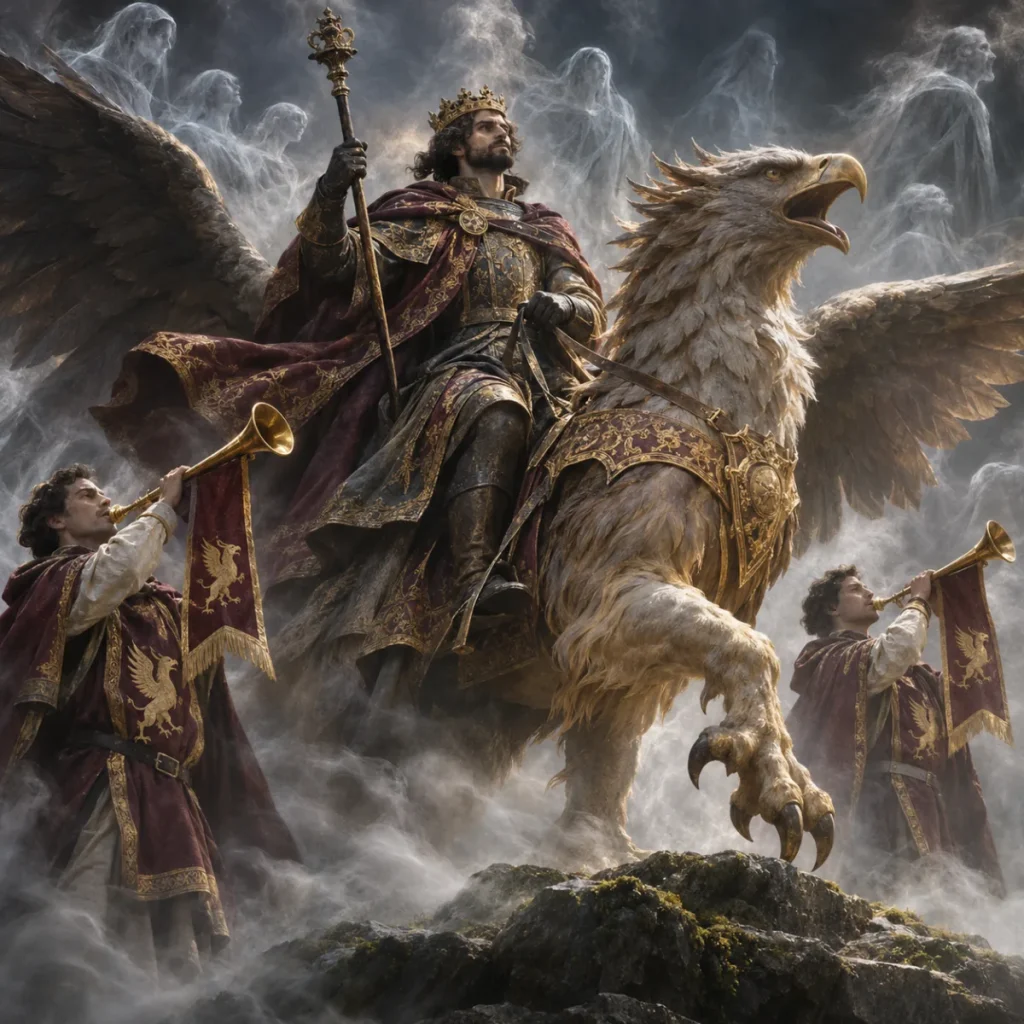
Two trumpeters clear the way; behind them comes a soldier wearing a duke’s crown, riding a griffin. Murmur’s entry in the Ars Goetia has something of a ceremonial procession about it, and his office is one of the gravest in the book: making the souls of the dead appear.
Who is Murmur in the Ars Goetia?
Murmur is spirit number 54 of the 72 spirits of the Ars Goetia. Sloane MS 3825, as transcribed by Joseph H. Peterson, calls him “a great duke & an Earle”: he holds two ranks, Duke and Earl. He rules 30 legions and, according to the text, “was partly of ye order of Thrones & partly of angels,” a double origin that is rare in the catalog.
What does Murmur look like?
He appears “In ye forme of a souldier ridding on a griffin with a dukes Crown on his head, there goeth before him two of his Ministers, wth great Trumpets sounding.” There is no transformation: the whole scene, small retinue included, is the manifestation.
What powers does the grimoire attribute to him?
Murmur’s office is “to teach Phylosophy perfectly, & to constraine soules deceased to come before ye Exorcist to answare those things yt he shall aske them.” It is one of the few entries in the Ars Goetia that is necromantic in the literal sense of the word: consulting the dead.
This is, of course, an attribution of the grimoire, not a practice with any demonstrated effect.
Murmur in Weyer: griffin or vulture?
In Johann Weyer’s Pseudomonarchia Daemonum (1577) Murmur is number 40, again a great Duke and Earl, with the soldier, the ducal crown, the two trumpeters, the philosophy and the souls compelled to answer. The double origin among Thrones and Angels matches as well.
There are two differences. The first is the mount: the Latin says equitans in vulture, “riding on a vulture.” It was Reginald Scot’s English translation that wrote “griphen,” and that is how the griffin reached the Ars Goetia. The second is the number: Weyer’s Latin text gives no legions, and the 30 appear as an addition in Scot’s version.
The name also varies across the manuscripts Peterson cites: Murmus in Sloane 3648, and Murmus or Murmux in other copies.
Murmur’s name and seal
In Latin, murmur means “a murmur” or “a low rumble.” It is tempting to connect it with the trumpets or with the voices of the dead, but none of the sources explains the name, and the variants Murmus and Murmux show the form was not fixed. That resemblance is best taken as a curiosity, not an etymology.
His seal, like those of the other spirits, is meant to be worn as a lamen.
What Murmur reveals
Murmur joins two ideas the grimoire treats as neighbors: philosophy and conversation with the dead. The pomp of his arrival, with crown, fabulous mount and heralds, underlines his double rank and makes his entry one of the most theatrical in the catalog. And the story of the vulture turned griffin is one more reminder of how much the Ars Goetia owes to its translators.
