
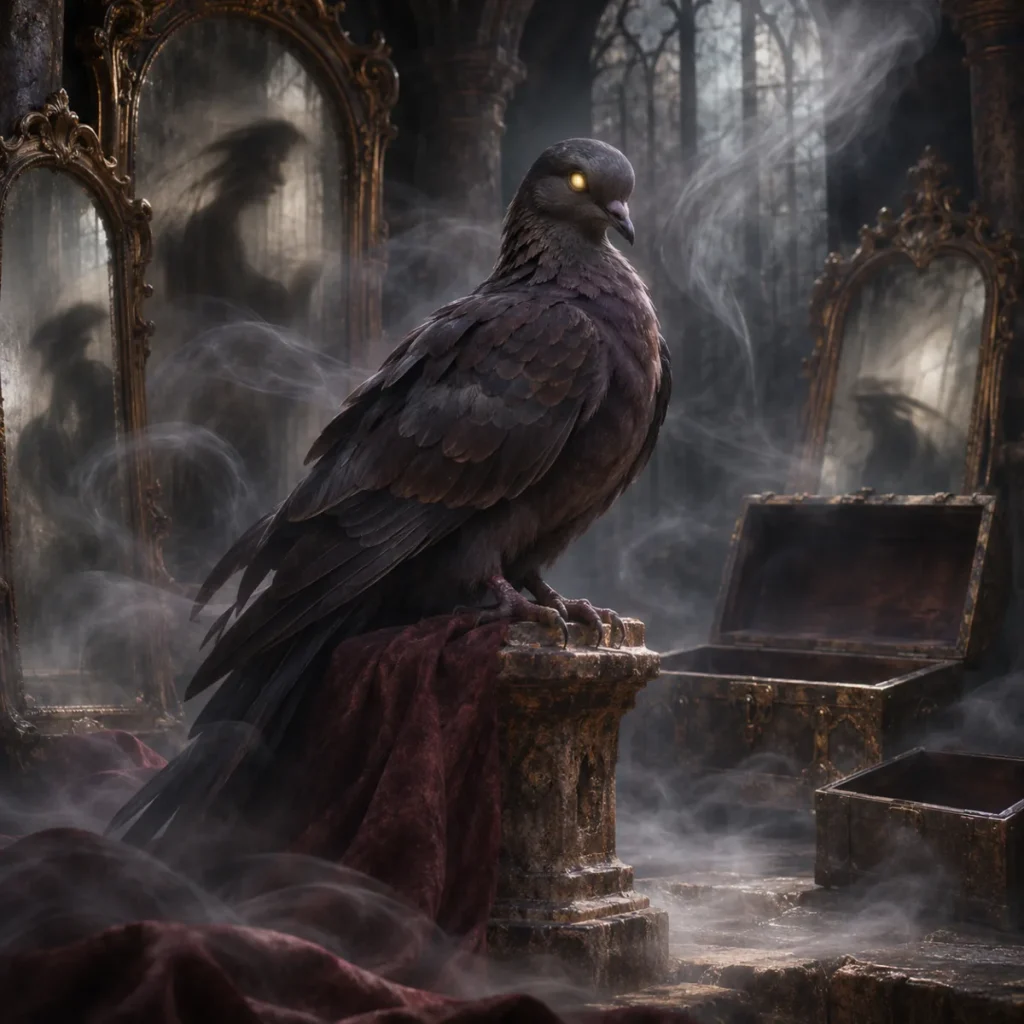
Taking away sight, hearing and understanding; stealing money from royal houses and bringing it back twelve hundred years later; lying unless confined to a triangle. Shax, the 44th spirit of the Ars Goetia, has one of the most unsettling and, at the same time, strangest entries in the catalog.
Who is Shax in the Ars Goetia?
In Joseph H. Peterson’s transcription of Sloane MS 3825, Shax is “a great Marquize” who governs 30 legions of spirits. The text gives him no angelic choir of origin. His profile is that of a powerful but unreliable spirit, one the grimoire itself surrounds with warnings.
What does Shax look like?
The manuscript says he appears “in ye forme of a stock dove, speaking wth a hoarse & subtill voyce.” It mentions no later human form.
The dove, however, is not in the Latin source. Weyer describes him as “like a stork” (similis ciconiae), and Reginald Scot’s translation says the same: “like unto a storke.” Everything points to the same stork/stock confusion that affects Halphas, whom Peterson restores to the form of a stork by following Weyer.
What powers does the grimoire attribute to Shax?
According to the manuscript, “his office is to take away ye sight, hearing & understanding of any man or woman at ye command of ye Exorcist, & to steal money out of kings houses & carry it againe in 1200 yeares, if commanded.” He will also “fetch horses or any Thing” the exorcist asks for, and “he can discover all Things that are hidden & not kept by wicked spirits.” He “giveth good familiars sometimes.”
The entry dwells on his falseness: “he must be commanded into a Triangle first or else he will deceive him, & tell you many lyes.” As with the rest of the 72 spirits of the Ars Goetia, all of this belongs to the attributions of a magical text, not to verifiable fact. What stands out is that the grimoire presents Shax as an ally not to be trusted, just like Furfur, who also won’t tell the truth outside the triangle.
Chax, alias Scox: Shax in Weyer
In Johann Weyer’s Pseudomonarchia Daemonum (1577), the spirit is entry 37 under the name “Chax, alias Scox”; Scot writes “Shax, alias Scox.” And here a difference of rank appears: the Latin calls him Dux et Marchio magnus, a duke and great marquis. Scot instead writes “a darke and a great marquesse,” and the Lemegeton leaves him as a marquis only.
Weyer is also more detailed about his character. In Scot’s words, “he is thought to be faithfull in all commandements: and although he promise to be obedient to the conjuror in all things; yet is he not so.” Weyer specifies that he takes money from “everie kings house” and calls him outright “a horssestealer.” Inside the triangle, he adds, Shax speaks of divine things and of hidden treasures not guarded by evil spirits; and the familiars he promises are “accepted if they be not deceivers,” as Scot puts it. The 30 legions match.
The seal of Shax and what it reveals
The manuscript presents his seal “to be made, and worne as a Lamin”; to reproduce it, start from a documentary edition. The entry itself leaves one of the clearest images of the distrust running through the grimoire: a spirit who can rob people of their senses, who returns what he steals on an impossible timetable, and whose word is worth something only under compulsion. More than a portrait of power, it is a portrait of deceit.
