
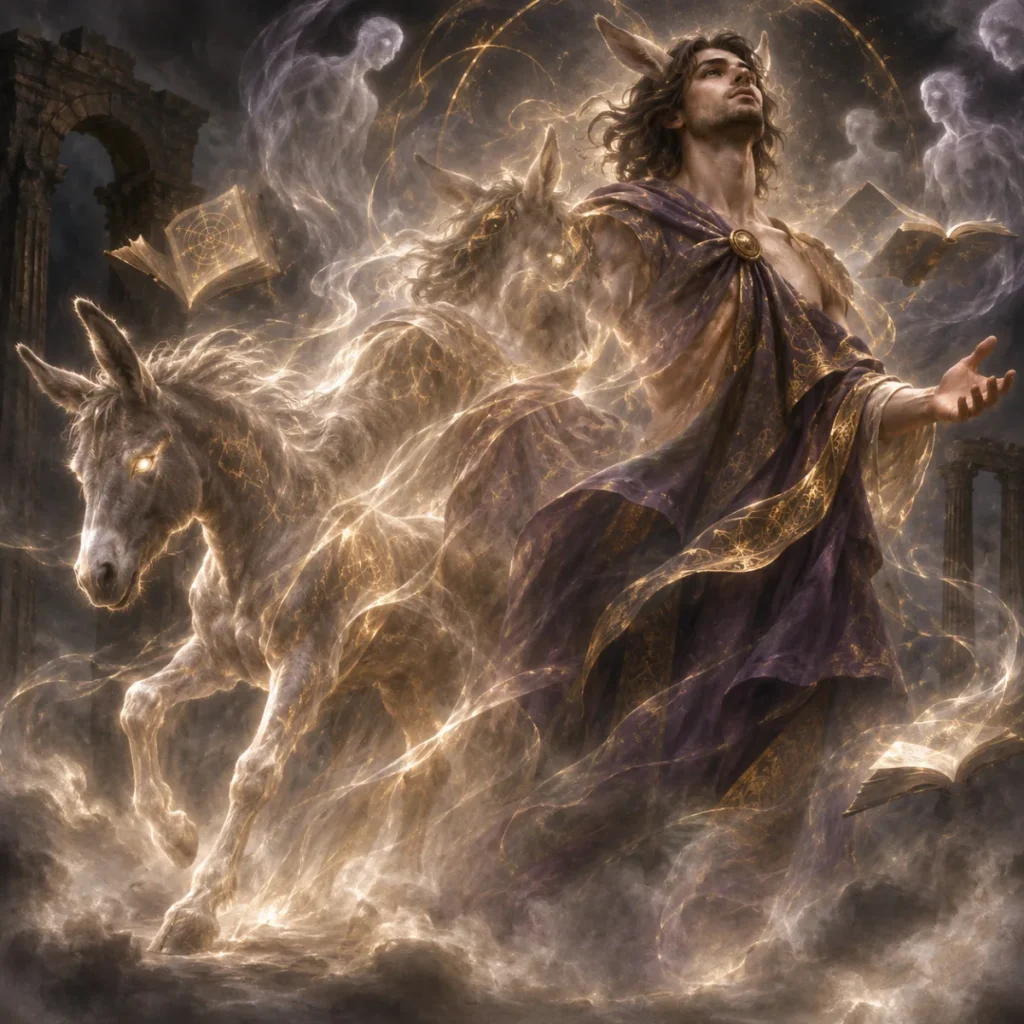
A little horse, or perhaps a donkey, that turns into a man at the magician’s request and speaks in a hoarse voice. Samigina, the fourth spirit of the Ars Goetia, pairs a humble image with two weighty offices: teaching the liberal arts and giving news of the souls of the dead.
Who is Samigina in the Ars Goetia?
The first thing to know is that Sloane MS 3825, as transcribed by Joseph H. Peterson, does not call him Samigina but Gamigin. Johann Weyer spells it Gamygyn, and other copies Peterson records name him Gagyne or Cogin. The form “Samigina,” the most widespread today, does not appear in Peterson’s transcription.
Whatever the name, the text presents him as “a great Marquise” who rules over 30 legions of lesser spirits. One of the copies Peterson cites, the Folger manuscript, links him with the West.
What does Samigina look like?
According to the Ars Goetia, he appears “in ye forme of a litle horse or asse,” then takes on human shape at the magician’s request, and “speaketh with a horse voice.”
That is not a pun on the horse, though it looks like one. In the manuscript’s English, horse is an old spelling of hoarse; the same copy says that Bael speaks “very horsly,” that is, very hoarsely. Weyer confirms it: his Latin reads raucam edit vocem, “he utters a hoarse voice.”
The donkey belongs to the Ars Goetia alone: Weyer mentions only a little horse.
What powers does the grimoire attribute to Samigina?
The manuscript gives him two offices. First, “he teaches all Liberall siences,” the body of learning that structured university education at the time. Second, he “giveth an account of ye dead soules of them that dye in sin.”
Both are attributions of the grimoire, not real abilities. The second also has an interesting textual history, because the copies disagree about it.
Samigina in Weyer and other copies
In the Pseudomonarchia Daemonum (1577), Gamygyn appears as entry 47 (Peterson’s note to the Ars Goetia gives 46). Weyer describes him as a great marquis in the form of a little horse who, once in human shape, discourses on all the liberal arts. The 30 legions match.
The difference lies in the souls. In Weyer, Gamygyn makes the souls of those drowned at sea, and of those who dwell in purgatory (“which is called Cartagra, that is, affliction of soules,” in Scot’s English), “take aierie bodies, and evidentlie appeare and answer to interrogatories.” He adds that the spirit stays with the exorcist until his wish is fulfilled.
The Ars Goetia boils all of this down to one sentence about the souls of sinners. Peterson notes that another copy of the Lemegeton, which he labels H, replaces that sentence with the passage about the drowned, much closer to Weyer. He also records that Harley MS 6483 adds that same passage to the entry for Amon, a sign that copyists moved fragments from one entry to another.
Samigina’s seal
The manuscript includes a seal for Samigina and specifies that the magician was to wear it. Like the other seals in the catalog, it does not come from Weyer, who reproduces none.
What this figure tells us
Samigina joins two worlds that seem far apart today: academic teaching and contact with the dead. In the culture that produced these texts they were not so distant; scholarly learning and curiosity about the afterlife shared the same books. His entry, with its variants of name and content, is also a lesson in how unstable the catalog of the 72 spirits was before modern editions fixed it.
