
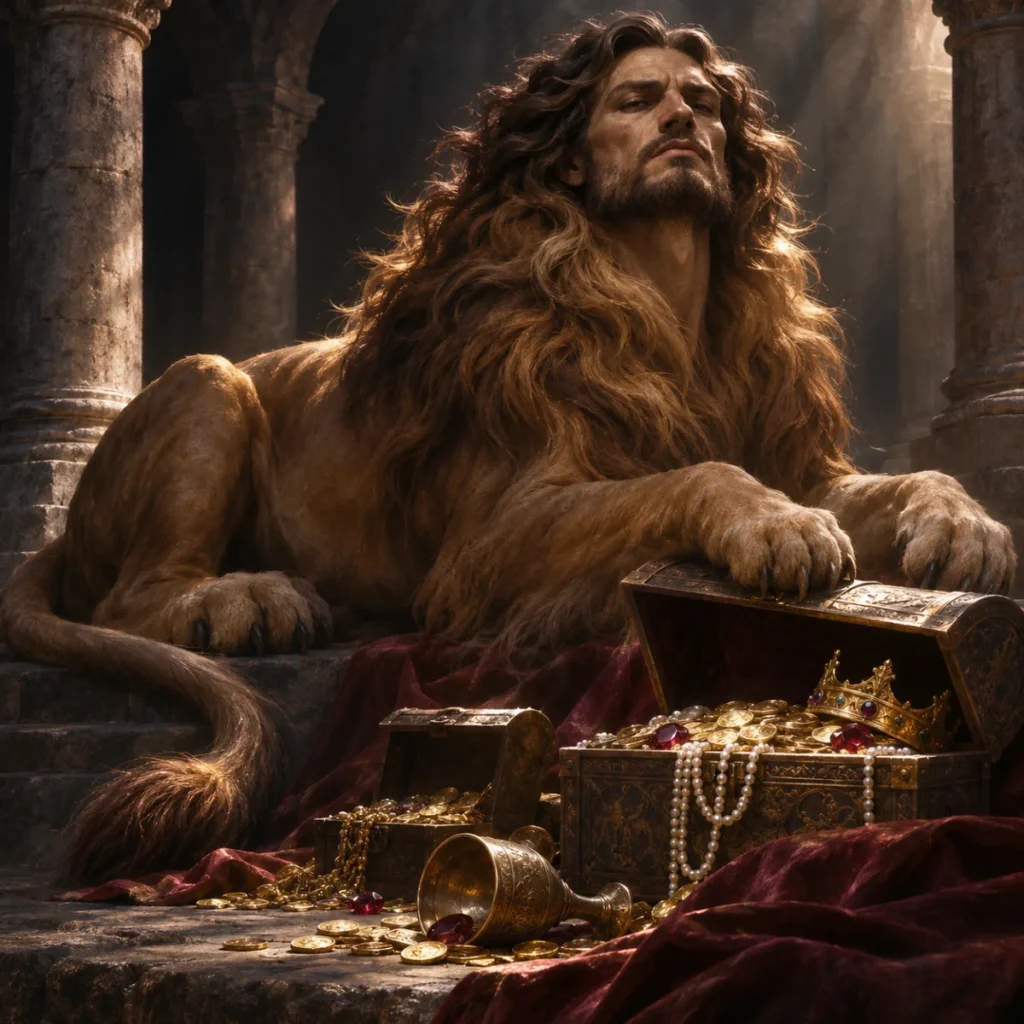
A good companion who ends up ruining you. Valefar, the sixth spirit of the Ars Goetia, is one of the few in the catalog whose entry reads like a warning: friendly to those who deal with him, he pushes them to steal. In his Latin source, the ending is darker still.
Who is Valefar in the Ars Goetia?
In Joseph H. Peterson’s transcription of Sloane MS 3825, Valefar is “a Mighty Duke” who governs 10 legions of spirits. That is one of the lowest figures in the entire catalog, a long way from the 200 legions of Paimon. The text mentions neither his cardinal direction nor the angelic choir he would have belonged to.
What does Valefar look like?
According to the manuscript, he appears “in ye form of a Lion with a mans head Lowring.” Lowring (today lowering) describes a dark, threatening, scowling expression. It is a hybrid image: the body of a beast, a human face and a hostile look.
There is nothing more about his voice or his size, and the text doesn’t say he changes shape, unlike Marbas, the lion just before him in the list, who does take human form.
What does the grimoire attribute to Valefar?
The entry is short and almost entirely about his character: Valefar “is a good femiliar, but tempteth those he is femiller with to steale.” A familiar, in the vocabulary of these texts, is a spirit that habitually accompanies and serves a person.
The manuscript adds a note about his seal, which is to be worn “constantly if you haue his familiarity. Else not.” More than a power, the text describes a dangerous relationship. Like everything in the catalog, it is a literary attribution rather than a verifiable fact, but its moral is plain.
Valefar in Weyer: the gallows at the end of the road
In Johann Weyer’s Pseudomonarchia Daemonum (1577), the spirit appears at number 14 as “Valefar, alias Malaphar,” a strong duke with the same 10 legions. The differences are telling.
First, the head. The Latin reads capite latronis, “with the head of a thief.” Reginald Scot’s English translation keeps “the head of a theefe,” and Peterson adds in brackets an alternative reading, “barking,” probably explained by the closeness of latro (thief) and the verb latrare (to bark). The Ars Goetia turned it into “a mans head.”
Second, the ending. According to Weyer, Valefar is familiar with his own donec laqueo suspendantur, “until they are hanged by the noose.” Scot renders it “till he hath brought them to the gallowes.” The Ars Goetia softens the line and keeps only the temptation to steal. The consequence, explicit in Weyer, is left implied.
Valefar’s seal
The manuscript presents Valefar’s seal with the warning already quoted: it is an object tied to familiarity with the spirit and not meant to be worn without it. Like the other seals of the Ars Goetia, it does not appear in Weyer.
A moral fable inside the grimoire
Valefar works almost like a fable. The helpful companion who leads to crime, and from crime to the gallows, embodies a fear that runs through the literature on magic of the period: dealing with spirits promises benefits, but it exacts a price. Among the 72 spirits of the Ars Goetia, few spell out that lesson so clearly in so few lines.
