
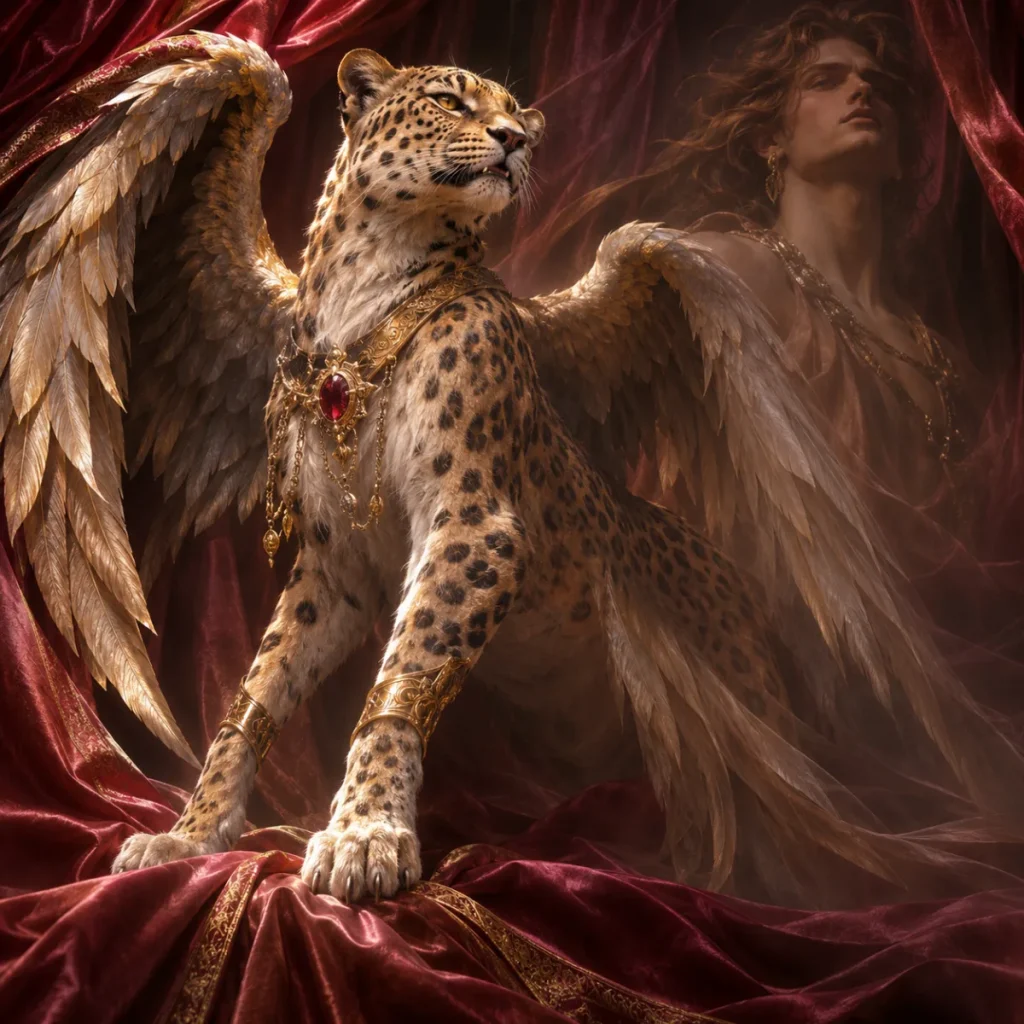
A leopard’s face and a griffin’s wings. Sitri, the twelfth spirit of the Ars Goetia, is one of the most striking hybrids in the catalog, and also one of the most openly tied to desire: his office is to kindle love between men and women.
Who is Sitri in the Ars Goetia?
In Joseph H. Peterson’s transcription of Sloane MS 3825, Sitri is “a great prince” who governs 60 legions of spirits. The text gives neither his cardinal direction nor the angelic choir he would have belonged to. He is one of the few princes on the list, a rank he shares with Vassago and Stolas.
What does Sitri look like?
According to the manuscript, he “appeareth at first with a Leopards face, and wings as a griffin.” Then, at the exorcist’s command, “he putteth on a humane shape very Beautifull.”
The combination is eye-catching. The leopard and the griffin, a fabulous creature with a lion’s body and an eagle’s head and wings, belong to the repertoire of bestiaries and heraldry. The text says no more: it doesn’t describe Sitri’s body in his first form, only the face and the wings. Images that show him with a full feline body or as a winged man fill in what the manuscript leaves open.
What powers does the grimoire attribute to Sitri?
The Ars Goetia focuses his powers on love. Sitri:
- inflames men “with womens Love”;
- inflames women “with mens love”;
- “causeth them to shew themselves Naked, if it be desired.”
These are attributions of a magical text, not real abilities. Read today, they reveal a fantasy of control over other people’s desire that runs through much of the love magic of the period. The catalog credits similar powers to other spirits, such as Beleth and Zepar.
Sitri in Weyer: alias Bitru
In Johann Weyer’s Pseudomonarchia Daemonum (1577), the spirit is number 21 as “Sytry, alias Bitru,” a great prince with the same 60 legions. The description matches: a leopard’s face, griffin’s wings and, in human form, a wondrous beauty.
Weyer is more explicit where women are concerned. According to his Latin, when commanded, Sitri willingly discloses women’s secrets, “laughing at them and mocking them,” so that they strip naked. The Ars Goetia tones the passage down to a neutral formula. The comparison exposes the misogyny of the source text, which the English compiler softened but did not remove.
Peterson records the alias in other copies: a British Library manuscript (Ad. 36674) calls him “Sytry alias Bytru,” and a copy at Trinity College, Cambridge, Bitur.
Sitri’s seal
The manuscript closes with “his seal to be worne is this.” Like every seal in the catalog, it does not appear in Weyer.
What Sitri reveals
Sitri is a good example of how the Ars Goetia blends images inherited from bestiaries with very human wishes. His hybrid figure, his beauty in human form and his hold over attraction explain much of his popularity. Reading his entry next to Weyer’s helps separate the visual appeal from the far less kindly content of the original text. The index of the 72 spirits of the Ars Goetia lets you compare him with the catalog’s other hybrid figures.
