
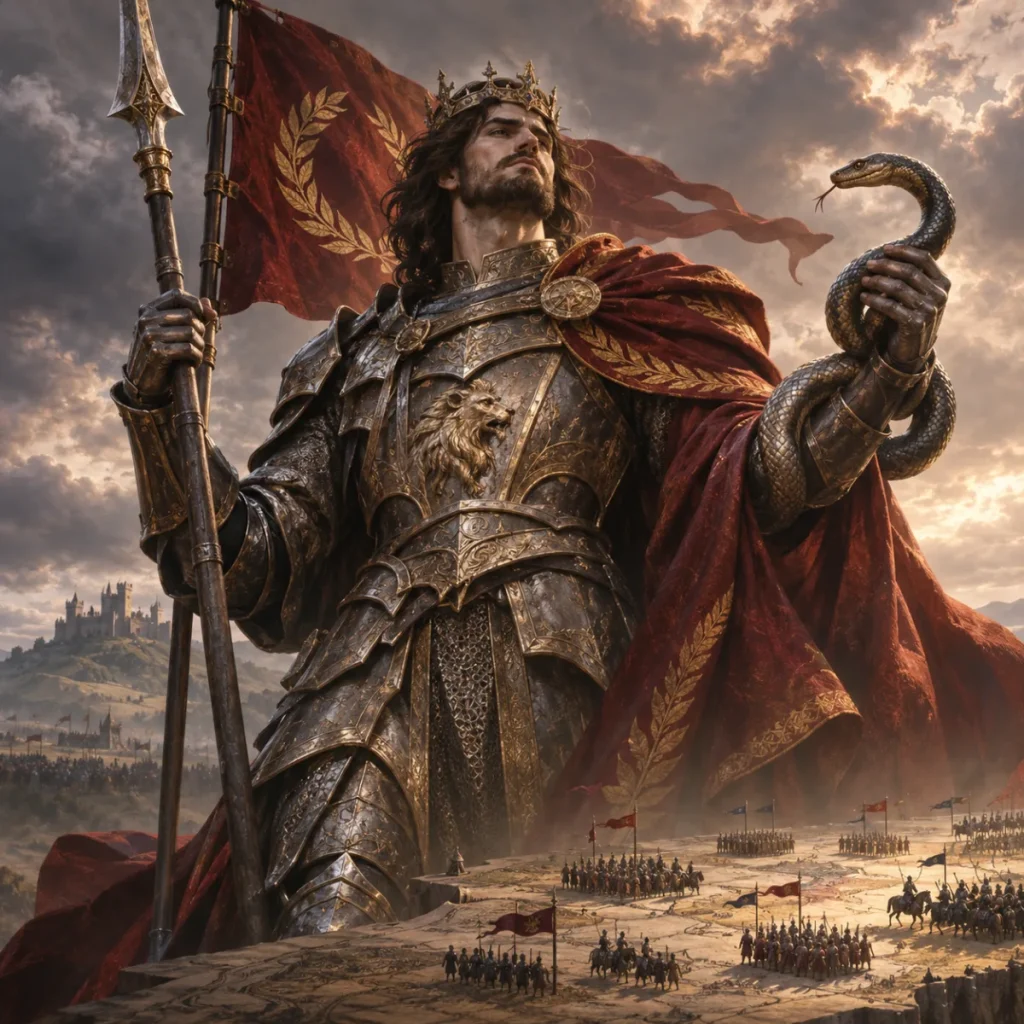
A handsome knight carrying a lance, a banner and a serpent. Eligos, the fifteenth spirit of the Ars Goetia, is one of the most martial figures in the catalog: he knows about wars, foresees how armies will meet and wins the favor of the powerful.
Who is Eligos in the Ars Goetia?
In Joseph H. Peterson’s transcription of Sloane MS 3825, the spirit is called Eligor. He is “a great duke” who governs 60 legions of spirits. Although he appears as a knight, his rank in the text is duke.
The form Eligos, very widespread today, also has manuscript support. Peterson notes that another copy of the Lemegeton (Sloane 3658) writes “ELIGOS,” that two other copies he labels H and C also read Eligos, and that the copy he calls S1 reads Eligor but adds in the margin: “in another copy ‘Eligos.’” The Folger manuscript, by contrast, calls him Allogor or Algor and places him in the East.
What does Eligos look like?
According to the Ars Goetia, he appears “in [the] form of a goodly knight carring a lance an Ensigne & a serpent.” “Goodly” here means handsome, and an ensign is a standard or banner. There is no transformation and there are no animal features: Eligos is a human, knightly figure from the start.
The serpent is the strangest detail of the description. As we’ll see, it is probably a product of the text’s transmission.
What powers does the grimoire attribute to Eligos?
According to the manuscript, Eligos:
- “discovereth hidden Things”;
- “knoweth things to come”;
- knows “of warres and how the soulders will & shall meet”;
- “causeth the love of Lords and great persons.”
Like the whole catalog, these are attributions of a magical text, not real abilities. Together they sketch the profile of a court adviser in wartime: he informs, anticipates and opens doors among the powerful.
Eligos in Weyer: Eligor, alias Abigor
In Johann Weyer’s Pseudomonarchia Daemonum (1577), the spirit is number 12 as “Eligor, alias Abigor,” a great duke with the same 60 legions. He appears as a most handsome knight carrying a lance, a standard and a scepter (sceptrum).
Here lies the key to the serpent: where Weyer and Reginald Scot’s English translation speak of a scepter, the Ars Goetia has a serpent. The sources don’t explain the change; it may be a misreading or a copyist’s choice, but either way the original attribute was an emblem of power, not an animal.
Weyer agrees on the rest: Eligos answers fully about hidden things and about wars, knows how soldiers should meet, knows the future and wins the favor of all lords and soldiers. The name has a long history: Peterson finds it as Alugor in a Latin manuscript in Munich and as Algor in several other copies.
The seal of Eligos
The manuscript presents his seal with a warning: it must be worn, “or else he will not appear nor obey you.” Like the other seals in the catalog, it does not come from Weyer.
Why Eligos matters
Eligos shows how a single object can change the meaning of an image: with a scepter he is a noble warrior; with a serpent he takes on an unsettling air. His entry connects with that of Zepar, the next spirit, who also appears armed like a soldier. To continue the journey, the Ars Goetia index gathers all 72 spirits.
