
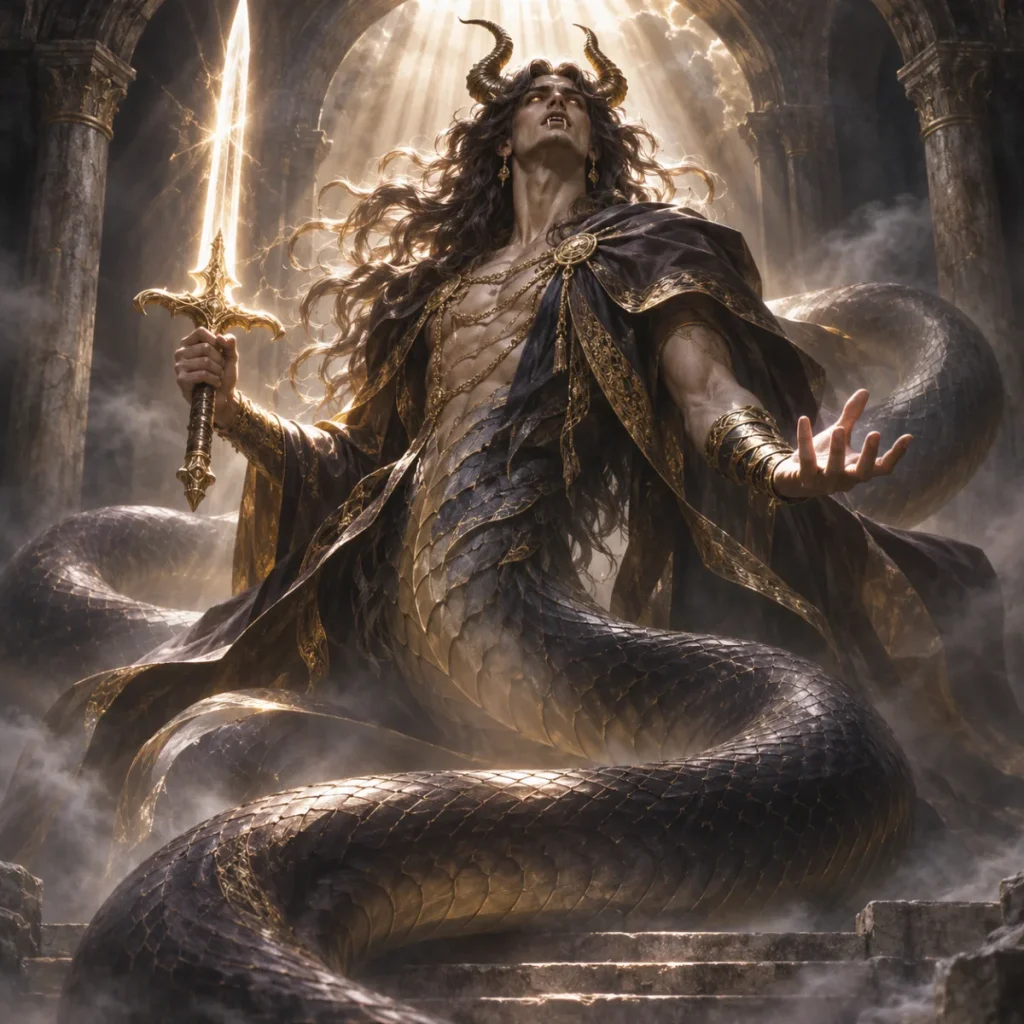
First, an ugly viper. Then a man with great teeth, two horns and a sharp, bright sword in his hand. Botis, the 17th spirit of the Ars Goetia, makes one of the most vivid two-stage appearances in the whole catalog, and his job sits oddly with his looks: telling the future and reconciling enemies.
Who is Botis in the Ars Goetia?
Sloane MS 3825, in Joseph H. Peterson’s transcription, introduces him as “a great president and an Earle.” He is one of the few spirits to hold two titles at once, and he governs 60 legions of spirits, one of the highest counts among the 72 spirits.
Ranks, legions and powers are all part of the hierarchy the grimoire builds. They are described here for what they are: attributions of a text, not verifiable facts.
What does Botis look like?
At his first showing, the manuscript says, he takes “the form of an ugly viper.” Then, “at the command of the Magician,” he “putteth on humane shape, with great teeth, two horns,” carrying “a sharp bright sword in his hand.”
The text says nothing more: no skin color, no shape for the horns, no clothing. Modern images that dress him as a warrior or give his human body serpentine features are free elaborations on that base.
What powers does the grimoire give him?
The Ars Goetia assigns him two functions:
- He “telleth of all things past and to come.”
- He “reconcileth friends and foes.”
The second power isn’t his alone. Glasya-Labolas, the 25th spirit, also “causeth love of friends and foes.” With Botis, though, reconciliation arrives in the hands of an armed and menacing figure, a contrast the text leaves unexplained.
Botis in Weyer: “alibi Otis”
Johann Weyer lists him as number 9 in his Pseudomonarchia Daemonum (1577) under the name “Botis, alibi Otis,” that is, called Otis elsewhere. The double rank and the 60 legions match. The differences are matters of nuance:
- In Weyer the human form appears “whenever he takes it on,” with no mention of any order from the magician. The operator’s control is an addition of the Lemegeton.
- Weyer’s Latin says he answers about things present, past and future, and also about hidden things; the English manuscript keeps only the past and what is to come.
- The sword is “sharp” in Weyer; the adjective “bright” comes from the English manuscript.
The seal of Botis
The manuscript closes the entry with a seal and specifies that it is the sign Botis “obeyeth when he seeth it.” The formula recurs in other entries of the catalog and shows what role the grimoire gives these signs: marks of authority over the spirit, not mere emblems.
Why Botis matters
Botis captures an idea that keeps returning in the Ars Goetia: the monstrous shows up first and only then becomes manageable. Even so, the human form keeps its teeth, its horns and its sword, as though the text wanted to remind us that the taming is never complete. Read that way, the spirit says as much about the fears of the people who copied the book as about the creature it describes.
