
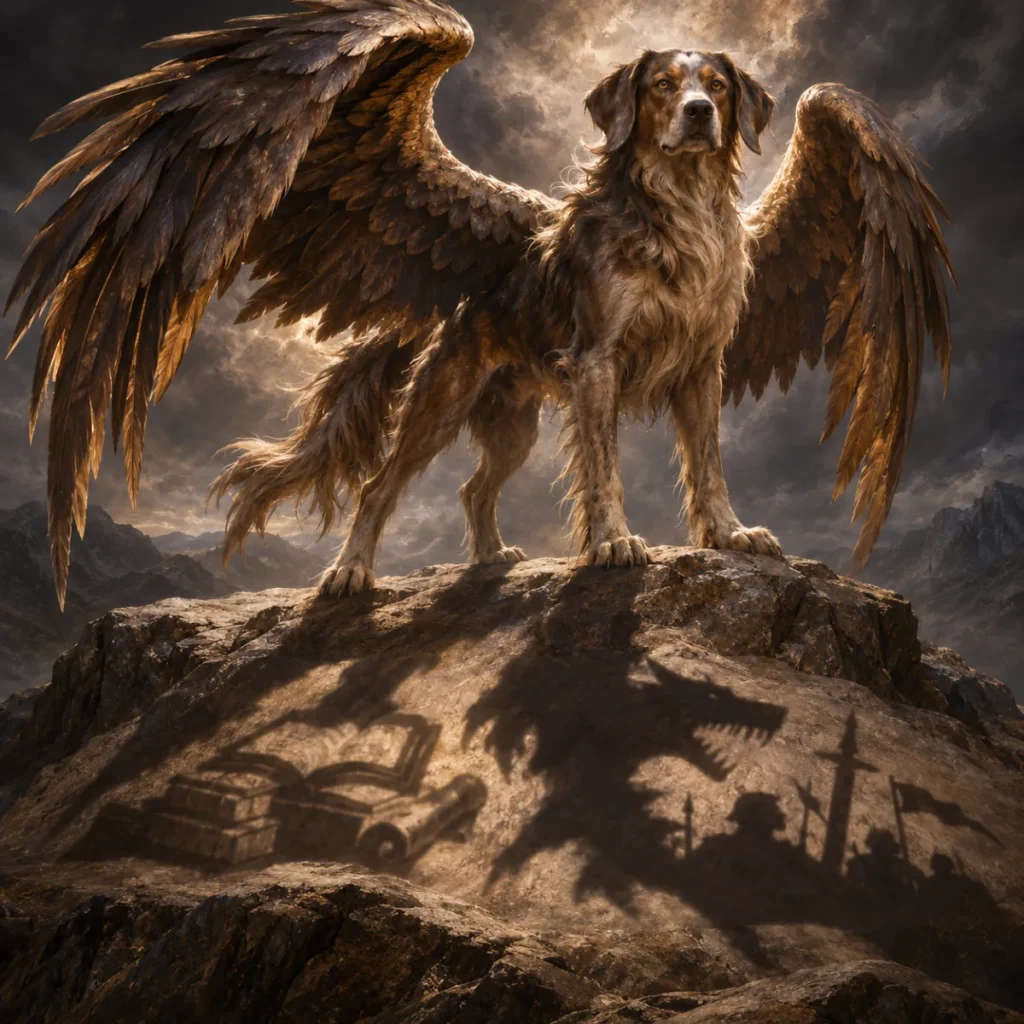
A dog with griffin’s wings who teaches every art in an instant and is, at the same time, “an author of Blood shed and Manslaughter.” Glasya-Labolas, the 25th spirit of the Ars Goetia, packs some of the most contradictory attributions in the whole catalog into a single entry.
Who is Glasya-Labolas in the Ars Goetia?
In Joseph H. Peterson’s transcription of Sloane MS 3825, the name is written Glasya Labolas, without a hyphen, and he is introduced as “a Mighty president” who governs 36 legions of spirits. President is his only rank: he does not appear as an earl in this source.
He holds 25th place among the 72 spirits. As throughout the catalog, his titles and powers are attributions of the grimoire, not verifiable realities.
What does Glasya-Labolas look like?
The text is brief: he shows himself “in the forme of a dog with wings like a griffin.” The griffin, a creature with a lion’s body and an eagle’s head and wings, was a familiar figure in heraldry and bestiaries; here it lends only its wings. No colors, size or other traits are mentioned.
What powers does the grimoire attribute to him?
The Ars Goetia’s list is as varied as it is contradictory:
- He “teacheth all arts in an Instant.”
- He is “an author of Blood shed and Manslaughter.”
- He “telleth all Things past and to come, if desired.”
- He “causeth love of friends and foes.”
- He “can make a Man goe Invisible.”
Invisibility links him to Bael, the first spirit of the catalog, whose signature power is exactly that. What sets Glasya-Labolas apart is that instant teaching and reconciliation sit alongside violence in the same figure.
Glasya-Labolas in Weyer: Caacrinolaas or Caassimolar
Johann Weyer records him as number 18 of his Pseudomonarchia Daemonum (1577) as “Glasya labolas, alias Caacrinolaas vel Caassimolar.” Those aliases come from Weyer and from Reginald Scot’s English translation; Peterson’s notes add the form Gloolas in the Folger manuscript.
The rank of president, the dog with griffin’s wings, the invisibility, the favor of friends and foes and the 36 legions all match. There are two nuances:
- Weyer calls him the “captain of all murderers,” a more hierarchical formula than the Lemegeton’s, which makes him the “author” of bloodshed.
- Weyer credits him with knowledge of things present and future; the English manuscript speaks of things past and to come.
The seal of Glasya-Labolas
According to the manuscript, his seal is to be worn “as a Lamin,” a plate the operator wears over the chest. Peterson’s edition reproduces it from the Sloane copy.
What Glasya-Labolas reveals
Glasya-Labolas shows that the spirits of the Ars Goetia don’t fit into simple moral categories. The same being who teaches and reconciles also leads the killers. Rather than a contradiction to be resolved, that mix reflects how the grimoire understands power: as knowledge that can serve any end. It is an interpretation, but it helps us read the entry without reducing it to a single trait.
