
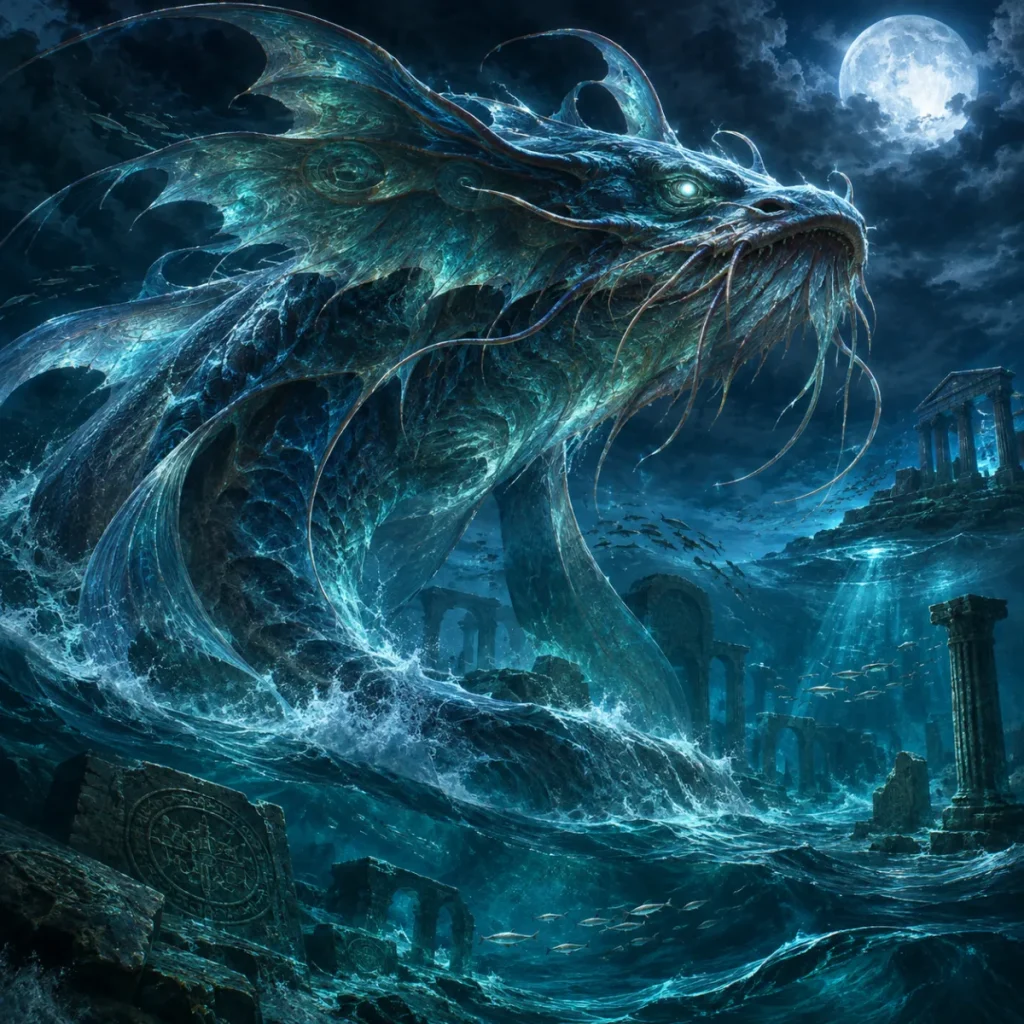
A monster risen from the sea that, instead of sinking ships, teaches people to speak well. Forneus, the 30th spirit of the Ars Goetia, is one of the catalog’s most curious cases: his appearance belongs to the deep, but his gifts belong to words, reputation and the art of dealing with other people.
Who is Forneus in the Ars Goetia?
Joseph H. Peterson’s transcription of Sloane MS 3825 calls him “a mighty great Marquiz.” He governs 29 legions of spirits, and the text is precise about where they come from: “partly of ye order of Thrones and partly of angels.” In other words, the grimoire gives him a heavenly past, as it does with several of the 72 spirits of the Ars Goetia who keep the memory of an angelic choir from before their fall.
What does Forneus look like?
The description is spare: he appears “in ye forme of a great sea Monster.” The text doesn’t say whether that means a fish, a serpent or a whale, and it gives him no colors, scales or tentacles. If an illustration turns him into a shark, a whale or a creature with a human face, that is the artist’s decision.
Unlike many of his companions in the catalog, Forneus is never said to take on a human shape afterward. The monster is his only image.
What powers does the grimoire attribute to Forneus?
His gifts revolve around communication and public image. According to the text, he “maketh men wounderfull knowing in ye art of Rhetoric,” causes them “to have a good Name,” and gives them “ye understanding of Tongues.” His last gift is the most striking of all: he makes men “beloved of their foes as well as they bee by their friends.”
These are, of course, attributions of a grimoire, not demonstrated abilities. But taken together they tell a story of their own. Eloquence, prestige, languages and good standing even with one’s adversaries add up to a portrait of the ideal courtier or diplomat, not of a destroyer.
Forneus in Weyer: a nearly identical forerunner
Forneus already appears in Johann Weyer’s Pseudomonarchia Daemonum (1577), as entry 25. The Latin calls him “magnus Marchio, similis monstro marino,” a great marquis resembling a sea monster, and credits him with exactly the same things: excellence in rhetoric, a good name, skill in languages and the favor of friends and enemies alike. The 29 legions and the mix of Thrones and Angels match as well.
Here the English Lemegeton follows Weyer very closely, by way of Reginald Scot’s translation, without adding new traits or losing any. It is one of the most stable entries in the whole chain of transmission.
One curious detail: in the same catalog, Ronove, who also appears “in ye forme of a Monster,” hands out very similar gifts: rhetoric, knowledge of tongues and the favor of friends and foes. The two form a small thematic family within the list.
The seal of Forneus
Like every spirit in the catalog, Forneus has his own seal, which, according to the manuscript, is “to be made and worne as aforesaid,” that is, as a lamen. To reproduce it faithfully, it is best to start from a documentary edition of the manuscript rather than from redrawn versions, which often alter the lines.
Why Forneus matters
Forneus shows that in the Ars Goetia appearance and function don’t always go hand in hand. His sea monster commands no storms or shipwrecks, unlike Focalor or Vepar; his domain is persuasion. That gap between image and office is one of the keys to reading the grimoire without reducing it to a bestiary of fear.
