
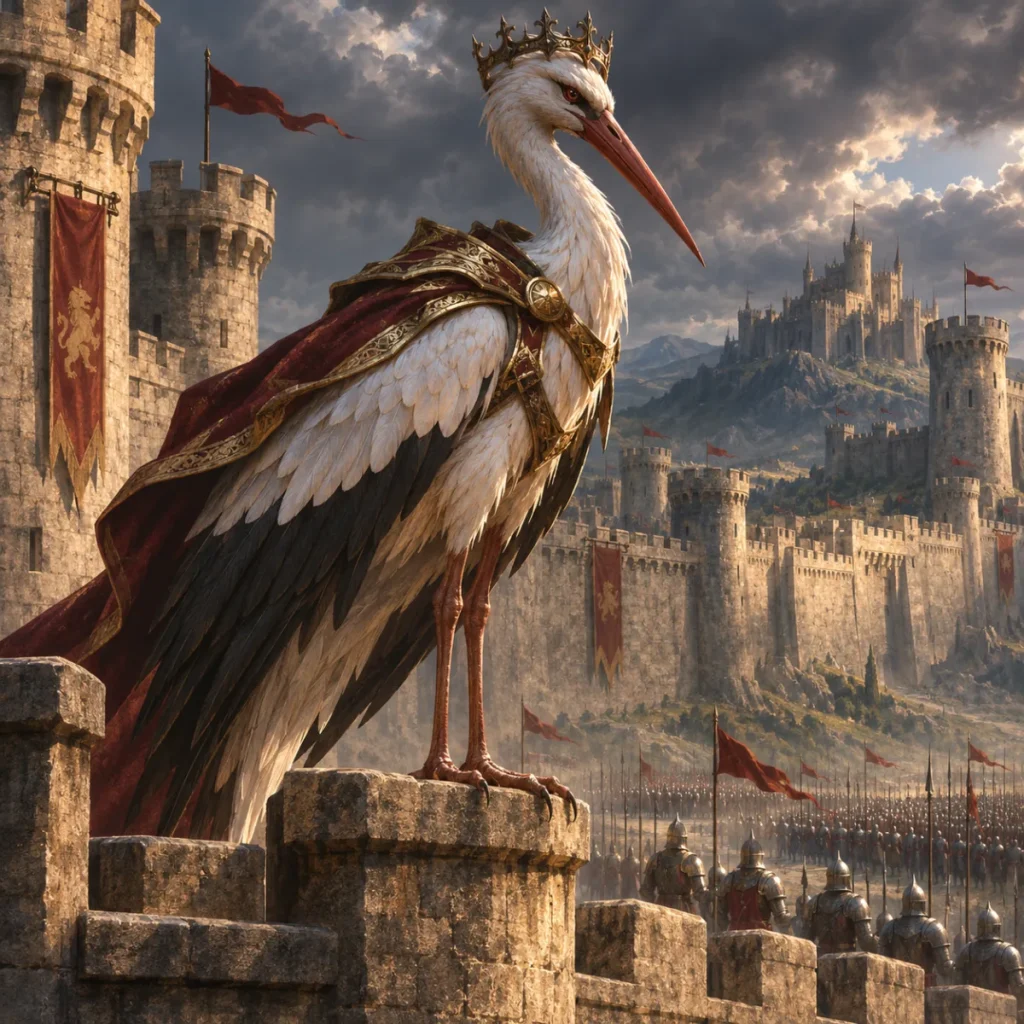
Dove or stork? Towers or towns? Few entries in the Ars Goetia show as clearly as Halphas’s how a single miscopied letter can change a spirit’s image. Behind those doubts stands a fairly clear figure: an Earl in the shape of a bird who deals in war.
Who is Halphas in the Ars Goetia?
In Joseph H. Peterson’s transcription of Sloane MS 3825, Halphas holds the 38th place among the 72 spirits of the Ars Goetia. He is “a great Earle” and rules over 26 legions of spirits. The text gives him no angelic choir of origin and no later human form: the bird is his only image.
What does Halphas look like: dove or stork?
This is where the trouble starts. Sloane MS 3825 says he appears “in ye forme of a stock,” and the transcription also records the word “dove.” Read that way, Halphas would be a stock dove, a kind of wild pigeon.
Peterson, however, corrects “stock” to “stork.” He relies on another Lemegeton manuscript, on Reginald Scot’s English translation (“like a storke”) and, above all, on Weyer’s Latin, which reads ciconia, a stork beyond any doubt. Everything suggests the dove was born of a copying error. What stays the same in every version is the voice: Halphas “speaketh wth a hoarse voyce.”
What powers does the grimoire attribute to Halphas?
His attributions are openly military. According to the manuscript, “his office is to build up Towers & to furnish them wth ammunition and weapons, and to send men of warre to places appointed.” As with the whole catalog, these are attributions of the grimoire, not real abilities; but they clearly sketch a spirit of wartime logistics rather than of combat.
There is a textual wrinkle here too. Peterson notes that Weyer writes oppida, “towns” or “strongholds,” and that Scot translates it “townes.” Only one of the English manuscripts, Sloane MS 2731, keeps the correct reading; Sloane 3825 and two others copied “towers.” Originally, Halphas did not build towers but whole towns full of weapons.
Halphas in Weyer
In Johann Weyer’s Pseudomonarchia Daemonum (1577), Halphas is entry 43. He is a great earl who “commeth abroad like a storke, with a hoarse voice,” who “notablie buildeth up townes full of munition and weapons,” in Scot’s rendering, and who sends men of war, when ordered, to the appointed place. The 26 legions match.
The Latin also contains a short phrase lost in the English version: bellum movet, “he stirs up war.” With it, Weyer makes him not only a supplier of armies but an instigator of conflict.
Halphas among the builders
Halphas is not alone in this specialty. Malphas, the next spirit, builds houses and towers; Sabnock raises towers, castles and armed cities. And the stork-or-dove confusion turns up again with Shax, whom Weyer also describes as a stork. The seal of Halphas, which the manuscript presents to be “worne as a Lamen,” is best reproduced from a documentary edition.
His entry leaves a useful lesson for any reader of the grimoire: before interpreting the symbolism of a dove preparing for war, check whether the dove was really in the text.
