
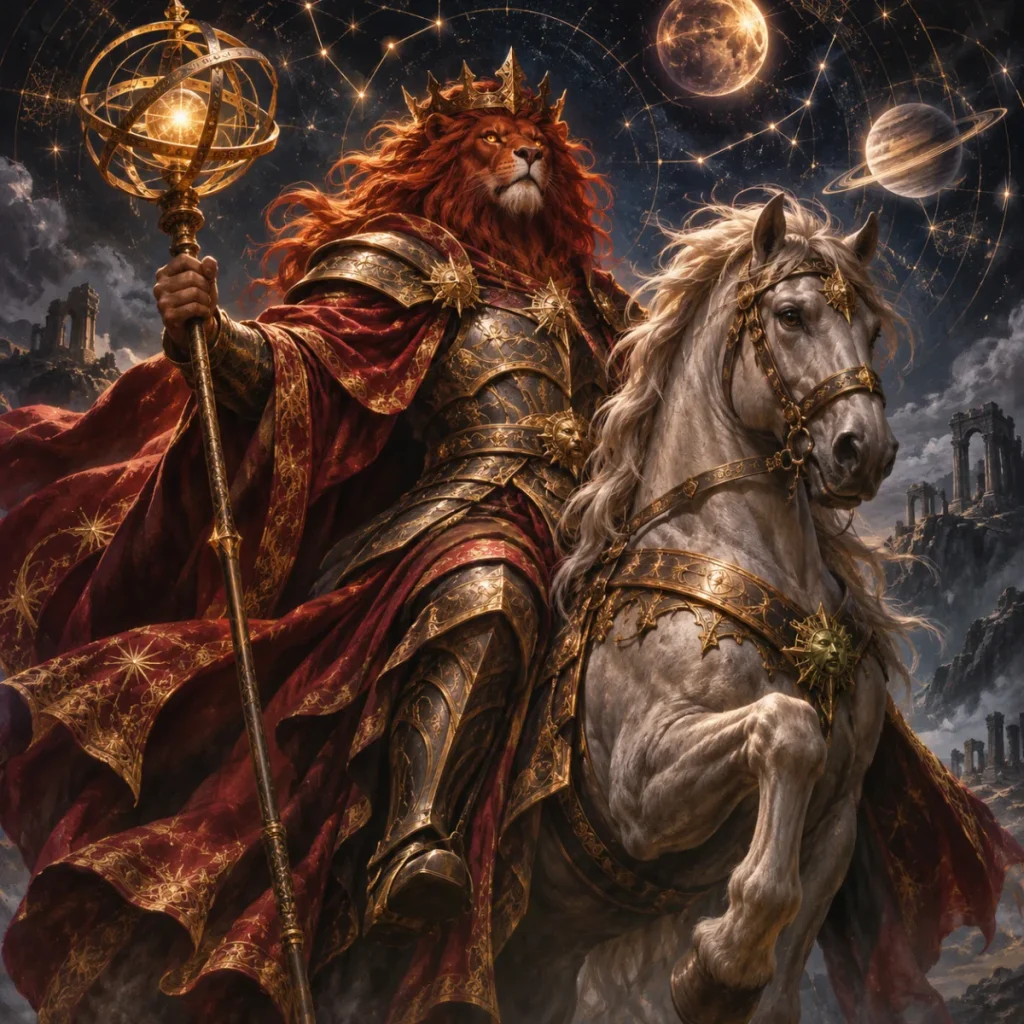
A soldier on a great horse, with a lion’s face of deep red, flaming eyes and a huge, hoarse voice. Alloces has every bit of a warrior’s presence, yet the Ars Goetia gives him a classroom job: teaching astronomy.
Who is Alloces in the Ars Goetia?
Alloces is spirit number 52 of the 72 spirits of the Ars Goetia. Joseph H. Peterson’s transcription of Sloane MS 3825 calls him “a great & mighty strong duke” and assigns him 36 legions of spirits.
His rank is Duke. The soldier in the description is his appearance, not his title: he should not be mistaken for a knight, a rank that in the catalog belongs only to Furcas.
What does Alloces look like?
He appears “in ye forme of a souldier ridding on a great horse; his face is like a Lyons, very redd, having Eyes flaming, his speech is hoarse & verry Bigg.” The text mentions no later transformation.
What powers does the grimoire attribute to him?
According to the text, his office is “to teach ye art of Astronomy, & all ye Liberall siences,” and “he Bringeth good familiars,” that is, helper spirits. It credits him with no prophecy, no treasure and no love matters: his profile is strictly that of a teacher. As with the rest of the catalog, these are attributions of a magical text, not verifiable abilities.
The pairing of liberal sciences and good familiars closely resembles that of Amy, spirit 58, although Amy teaches astrology rather than astronomy, and his appearance has nothing in common with Alloces’s.
Alloces in Weyer: Alocer
In Johann Weyer’s Pseudomonarchia Daemonum (1577) he is number 64 under the name Alocer; Reginald Scot’s English translation spells it Allocer. The description matches: a great and strong duke, a soldier on an enormous horse, a very red lion’s face, fiery eyes, astronomy, the liberal arts, good familiars and 36 legions.
The nuance lies in the voice. Weyer says graviter loquitur, “he speaks gravely,” and Peterson glosses Scot’s “big voice” as “very deep.” The adjective “hoarse” in the Ars Goetia adds a trait the Latin doesn’t have.
Alloces’s seal
The Ars Goetia provides a seal for Alloces, to be made and worn. As with the rest of the catalog, it is worth distinguishing reproductions from identified manuscripts from modern redrawn designs.
What Alloces reveals
Alloces sums up a recurring paradox of the Ars Goetia: fierce-looking figures whose job is to pass on knowledge. The red lion and the burning eyes speak of power; astronomy and the liberal arts speak of the curriculum of the day. The grimoire saw no contradiction between the two, and that may be the key to reading it: knowledge, too, was imagined as a formidable force.
