
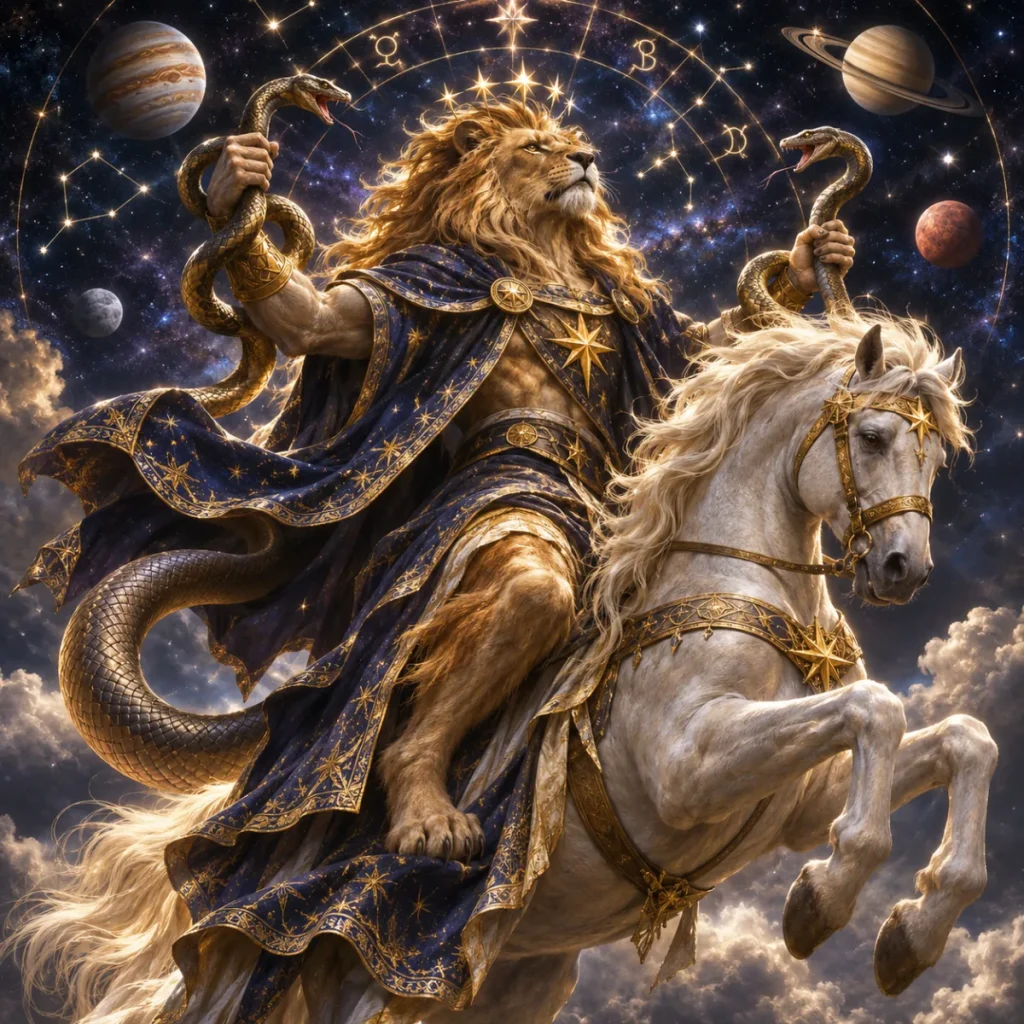
A lion on horseback, a serpent’s tail, and two great serpents hissing in his right hand. Few entries in the Ars Goetia crowd so many animals into a single scene, and few give their spirit such a learned trade: Orias, the 59th spirit, is the Marquis to whom the grimoire entrusts the knowledge of the stars.
Behind that bestiary image lies a short, well-preserved entry that barely changed on its way from Johann Weyer’s catalog to the English manuscripts of the Lemegeton.
Who is Orias in the Ars Goetia?
In Joseph H. Peterson’s transcription of Sloane MS 3825, Orias is “a great Marquiz” in command of 30 legions of spirits. He holds place 59 among the 72 spirits of the Ars Goetia, in the last stretch of the catalog, where several marquises cluster together. Like everything else in the book, his rank and legions belong to the grimoire’s own internal hierarchy.
What does Orias look like?
The text presents him in the form of a lion “riding on a mighty horse, wth a serpents Taile,” holding in his right hand “2 great serpents hissing.”
The phrase leaves one question open: does the serpent’s tail belong to the lion or to the horse? The manuscript’s English doesn’t say. Weyer’s Latin (visitur ut leo, in equo fortissimo equitans, cauda serpentina) isn’t entirely explicit either, though the word order suggests the tail belongs to the lion himself. What is clear is that the serpents are held in one hand only, the right; illustrations that split the snakes between both hands are already interpreting.
What powers does the grimoire attribute to Orias?
His main office is “to Teach ye vertues of ye starres and to know ye Mansions of ye planets, and how to understand their vertues.” This is the vocabulary of the astrology of its day, not of modern astronomy: the aim is not to measure the sky but to interpret it.
A second, more worldly set of functions follows. Orias “Transformeth men,” grants dignities, prelacies and confirmations, and procures “ye favour of friends & foes.” Peterson notes that where Sloane 3825 reads “places,” Weyer, Scot and other manuscripts read “prelacies,” that is, church offices.
All of this is best read for what it is: the grimoire’s attributions, not demonstrated abilities. What makes it interesting is what it reveals about the reader its copyists imagined, someone who wanted celestial knowledge and social advancement at the same time.
Orias in Weyer: an almost identical entry
Orias appears in Johann Weyer’s Pseudomonarchia Daemonum (1577) as spirit 49, also a Marquis and also with 30 legions. The description matches point for point: the lion, the horse, the serpent’s tail and the two hissing serpents in the right hand.
The only difference is one of nuance. In Weyer’s Latin, Orias “knows” (callet) the mansions of the planets and “perfectly teaches” the virtues of the stars; the Ars Goetia folds both into his teaching office. It is a good example of how faithful the transmission could be in some entries, compared with others that changed a great deal along the way.
The seal of Orias
Like every spirit in the catalog, Orias has his own seal, which, according to the manuscript, was to be made and worn as a lamen. The grimoire’s general rules assign a metal to each rank; in Peterson’s reading, the seals of marquises correspond to silver. To reproduce the design faithfully, start from an identified manuscript witness, not from redrawn versions.
What Orias reveals
Orias shares with Stolas an interest in the stars, but his image is far more aggressive: a predator armed with serpents. A modern reader might see in it the idea that knowledge of the sky is also a form of power over human affairs. That is an interpretation, not something the text says; what the text does show is how the grimoire fuses astrology, prestige and menace into a single figure.
