
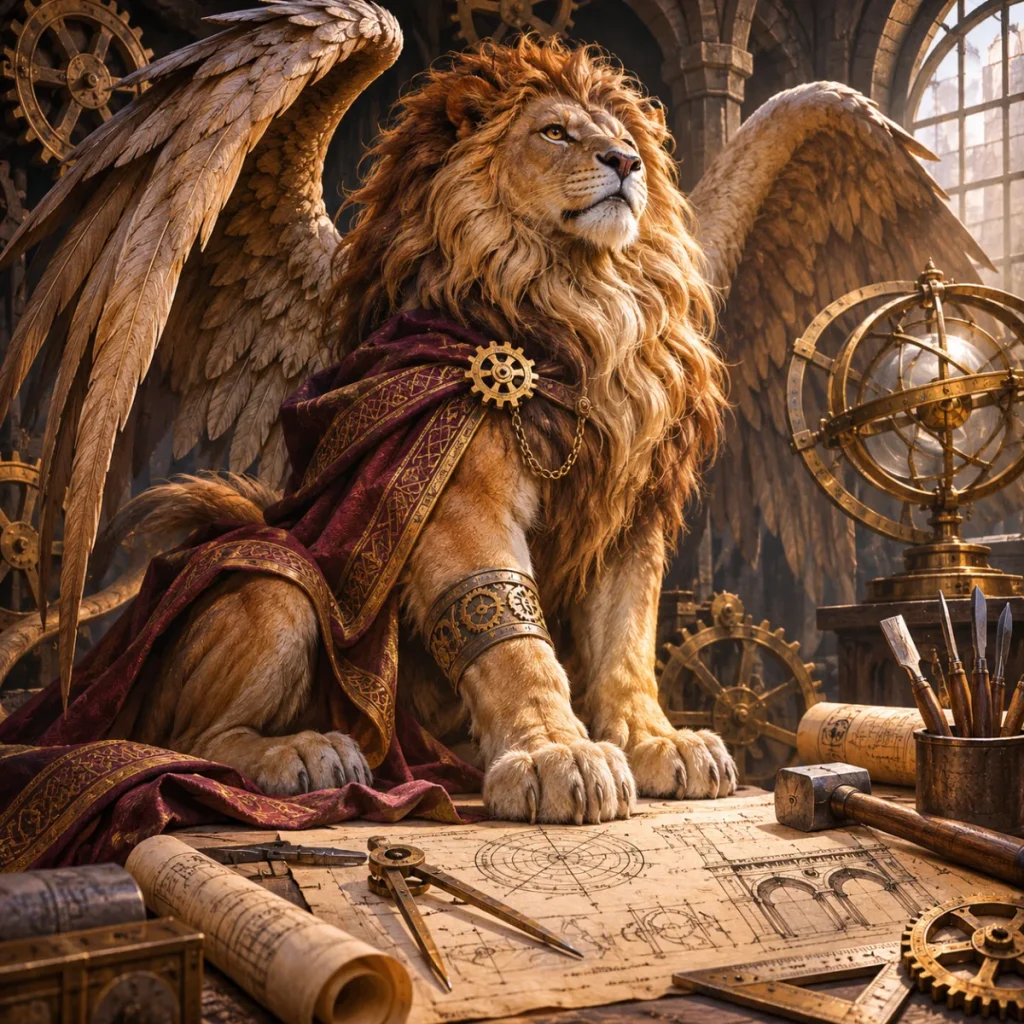
A lion with griffin’s wings that promises neither treasure nor revenge, but a trade. Vapula, the 60th spirit of the Ars Goetia, is one of the few in the catalog whose specialty is the manual and mechanical arts, alongside philosophy and the sciences.
Who is Vapula in the Ars Goetia?
Joseph H. Peterson’s transcription of Sloane MS 3825 describes him as “a great mighty & strong duke” who governs 36 legions of spirits. He holds place 60 among the 72 spirits of the Ars Goetia.
His is one of the shortest entries in the book: appearance, office, legions and seal, with no warnings and no conditions. That sobriety is itself one of Vapula’s traits.
What does Vapula look like?
The text says only that he appears “in ye forme of a Lyon, wth griffins wings.” It mentions no later change into human form, as happens with so many other spirits in the catalog.
Griffin’s wings are a motif the grimoire repeats in this part of the list: Zagan and Haagenti both appear as bulls with the same wings. The griffin, half eagle and half lion, lends Vapula’s figure a note of double nature, but the manuscript explains no symbolism. It simply describes.
What powers does the grimoire attribute to Vapula?
According to Sloane 3825, his office is “to make men knowing in all handicraft proffecsions,” and also “in Phylosophy & other siences.”
Peterson makes two useful observations here. First, the underlying Latin term, mechanicus, is better translated as “mechanical arts,” as in the entry for Marbas, another lion-shaped spirit credited with that knowledge. Second, the word “professions” is not found in Scot or in one of the other manuscripts he collates, so it is probably a gloss added by a copyist.
In the premodern classification of knowledge, the “mechanical arts” were the practical trades, as opposed to the liberal arts. A grimoire that promises mastery of them proves nothing about its efficacy: this is a literary attribution, not a real ability. But it does show that the wish to learn a trade had its place in these lists too.
Vapula in Weyer and other versions
Vapula appears in Johann Weyer’s Pseudomonarchia Daemonum (1577) as spirit 59, with the same name, the same rank of Duke and the same 36 legions. Weyer describes him as a lion with griffin’s wings who makes a man subtle and wonderful in the mechanical arts, in philosophy, and in “sciences conteined in bookes,” as Reginald Scot’s English has it.
That last nuance, book learning, fades in the Ars Goetia, which speaks only of “other siences.” Among the variants Peterson records in other manuscripts is the form Balpala.
Vapula’s seal
The manuscript says his “seal or Character” is to be made and worn as a lamen. In the grimoire’s general rules, the seals of dukes are associated with copper. As with any sigil, it is best reproduced from an identified manuscript witness.
Why Vapula matters
Vapula is a reminder that the catalog is not just a parade of threats. Several of its entries answer very concrete aspirations of the people who copied these texts: to learn, to master a trade, to gain technical skill. Read this way, the winged lion works as an image of practical knowledge, though that reading is ours, not the manuscript’s.
