
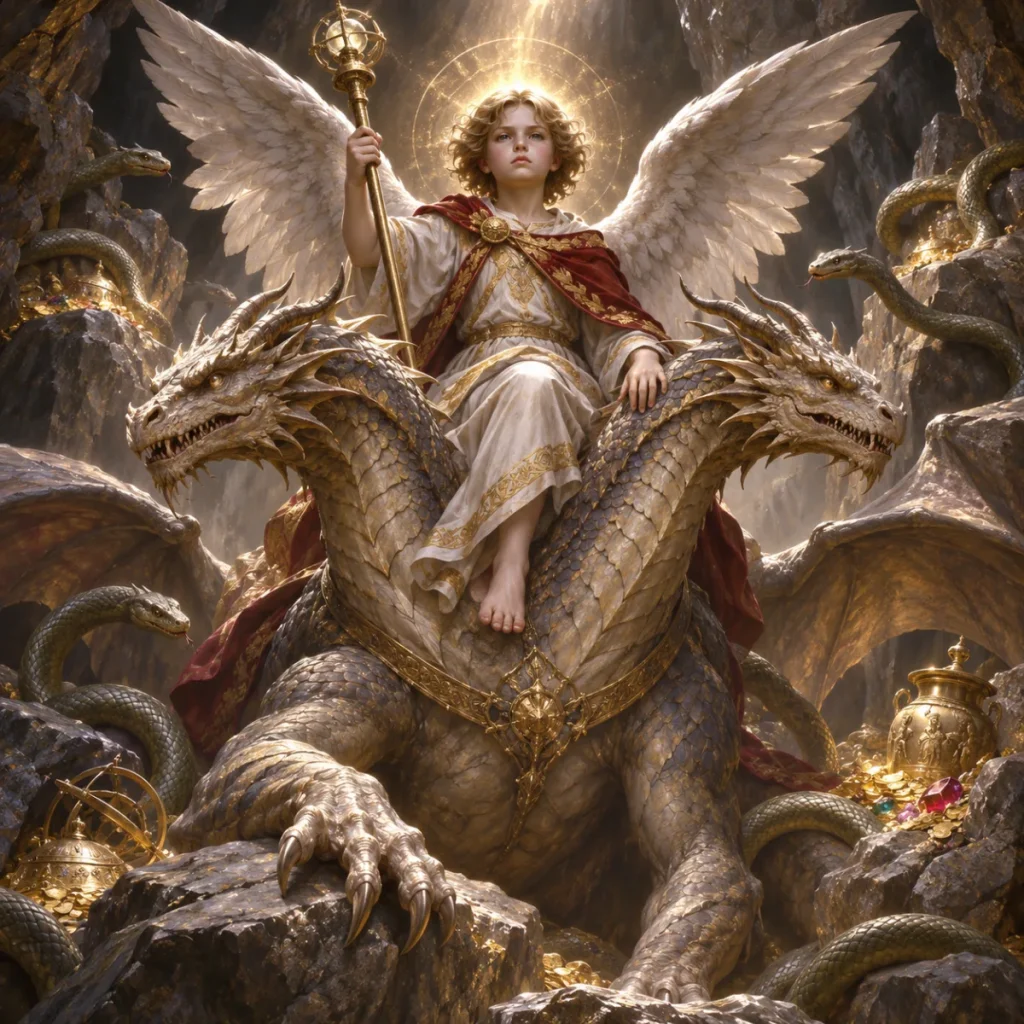
A boy with angel’s wings riding a two-headed dragon. The image of Valac, the 62nd spirit of the Ars Goetia, is one of the most disconcerting in the catalog: innocence and monster in a single figure, in the service of a very specific trade, finding treasures and serpents.
In Johann Weyer’s Pseudomonarchia Daemonum his name is Volac, which is why both forms, Valac and Volac, still live side by side today.
Who is Valac in the Ars Goetia?
Joseph H. Peterson’s transcription of Sloane MS 3825 introduces him as “a mighty great president” in command of 30 legions of spirits. He holds place 62 among the 72 spirits of the Ars Goetia.
Weyer gives the same number of legions. Some modern summaries credit him with 38, but that figure appears in neither source.
What does Valac look like?
The text is terse: he appears “like a Boy wth angels wings, ridding on a 2 headed Dragon.” There is no later transformation and no detail of clothing or weapons.
The contrast is what makes Valac memorable. The childlike, angelic figure, which in other contexts would be a protector, appears here mastering a two-headed creature. The manuscript does not explain the symbolism, so any reading of that tension is the interpreter’s own.
What powers does the grimoire attribute to Valac?
According to Sloane 3825, Valac gives “True answares of hidden Treasures” and tells “where serpents may be seene,” which he will bring and deliver to the exorcist “without any force or strengeth.”
The English phrase is ambiguous: it could mean that Valac hands the serpents over effortlessly, or that the serpents arrive without strength. Weyer’s Latin settles the matter: the serpents are delivered viribus destitutos, “deprived of strength,” that is, harmless. Reginald Scot’s English translation reads the same way: “void of anie force or strength.”
Both powers, revealing treasure and subduing serpents, are attributions of the grimoire, not demonstrated abilities. But they say a great deal about the fears and desires of the age: hidden wealth, and the danger of venomous animals.
Valac, Volac and other variants
In the Pseudomonarchia Daemonum (1577), the spirit appears as Volac, number 50 in the catalog, with the same rank of President, the same image of the winged boy on the two-headed dragon and the same 30 legions. Scot’s translation already spells the name Valac, the form the Ars Goetia adopts.
Peterson also records the form Volach in other manuscript catalogs of spirits. The name, then, wavers mainly between the o and the a of its first syllable.
Valac’s seal
Like the other spirits of the catalog, Valac has a seal which, according to the manuscript, “must be made & worne as a Lamin.” The grimoire’s general rules associate the seals of presidents with mercury. To study it rigorously, start from a faithful reproduction of an identified manuscript.
What Valac reveals
Valac belongs to the group of spirits in the catalog who specialize in finding treasure, a constant concern in the magical literature of the early modern period. His distinctive trait is the serpent: he does not turn it into a weapon but hands it over disarmed. A contemporary reader might see in this the promise of mastering a natural danger; that is an interpretation, not a fact of the text, but it helps explain why his figure is so striking.
