
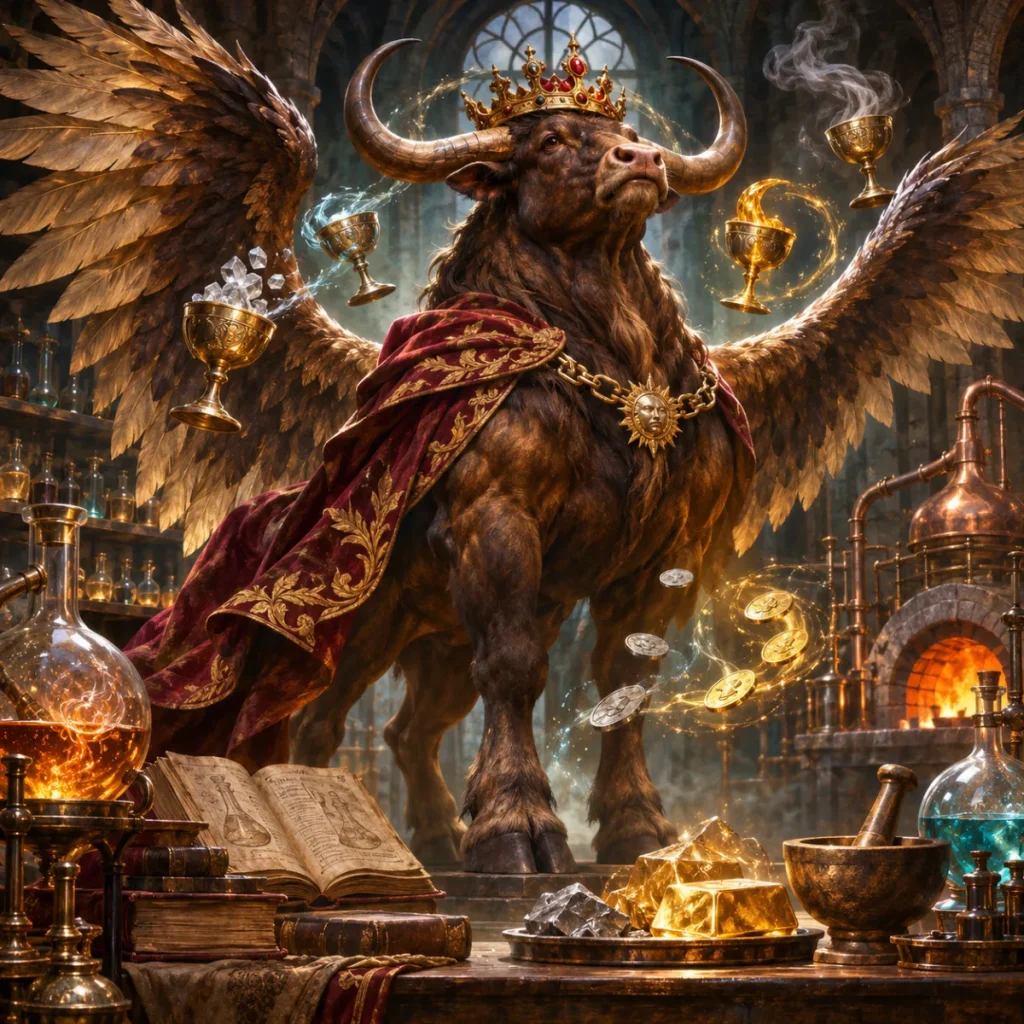
Water into wine, wine into water, metal into coin and fools into wise men. Zagan, the 61st spirit of the Ars Goetia, is the catalog’s great transformer: a King and President who appears as a winged bull and whose office is to change the nature of things.
Who is Zagan in the Ars Goetia?
In Joseph H. Peterson’s transcription of Sloane MS 3825, Zagan is “a great king & president” in command of 33 legions of spirits. He is one of the few among the 72 spirits of the Ars Goetia to hold a double rank, and one of the catalog’s few kings.
These titles belong to the grimoire’s own hierarchy. They are not historical offices but the way the book orders its cast of characters.
What does Zagan look like?
Zagan appears “at first in ye forme of a Bull wth griffins wings” and later takes human shape. The text does not say the change happens at the exorcist’s command; it says only that it happens “afterwards.”
The image is almost identical to that of Haagenti, spirit 48, also a bull with griffin’s wings who turns water into wine. The resemblance between the two entries is one of the clearest internal echoes in the catalog.
What powers does the grimoire attribute to Zagan?
Sloane 3825 lists them in one breath: “he maketh men witty, and can turne wine into water & Blood into wine, and also water into wine”; he can turn all metals into coin “of that dominion ye mettles are of,” and he “can make foolls wise.”
The list does not include the turning of wine into blood that modern summaries often add: blood appears only as something turned into wine. All of this, it should be said, consists of the grimoire’s attributions, not verifiable facts.
Zagan in Weyer: the wine that was oil
Zagan appears in Johann Weyer’s Pseudomonarchia Daemonum (1577) as spirit 48, with the same double rank of King and President and the same 33 legions. But there is a telling difference. Weyer’s Latin says he turns blood into oil and oil into blood (sanguinem quoque in oleum, & contrà).
Reginald Scot’s English translation put “wine” where the Latin says oleum, and Peterson corrects that reading. Sloane 3825 keeps the version with wine, which suggests the English catalog inherited the translation’s slip rather than the Latin original.
Peterson also records other traces of Zagan: he is among the spirits mentioned by Trithemius in his Polygraphia, and in the Folger manuscript he appears as Zagayne, associated with the West. A 1660 edition of Weyer’s works misprinted him as Zagam.
Zagan’s seal
The manuscript says his seal is to be made and worn as a lamen. The grimoire’s rules assign a metal to each rank but, as Peterson observes, they do not say what to do with double-ranked spirits like Zagan. Any reproduction of the design should start from an identified manuscript witness.
What Zagan reveals
Zagan’s transformations, especially water into wine, invite modern readings that see him as an echo or a parody of biblical miracles. The text does not say so. What it does show is a very material set of concerns: coins, metals, drink and understanding. Zagan gathers into one entry the fantasy of changing the substance of things and the fantasy of changing people’s minds.
