
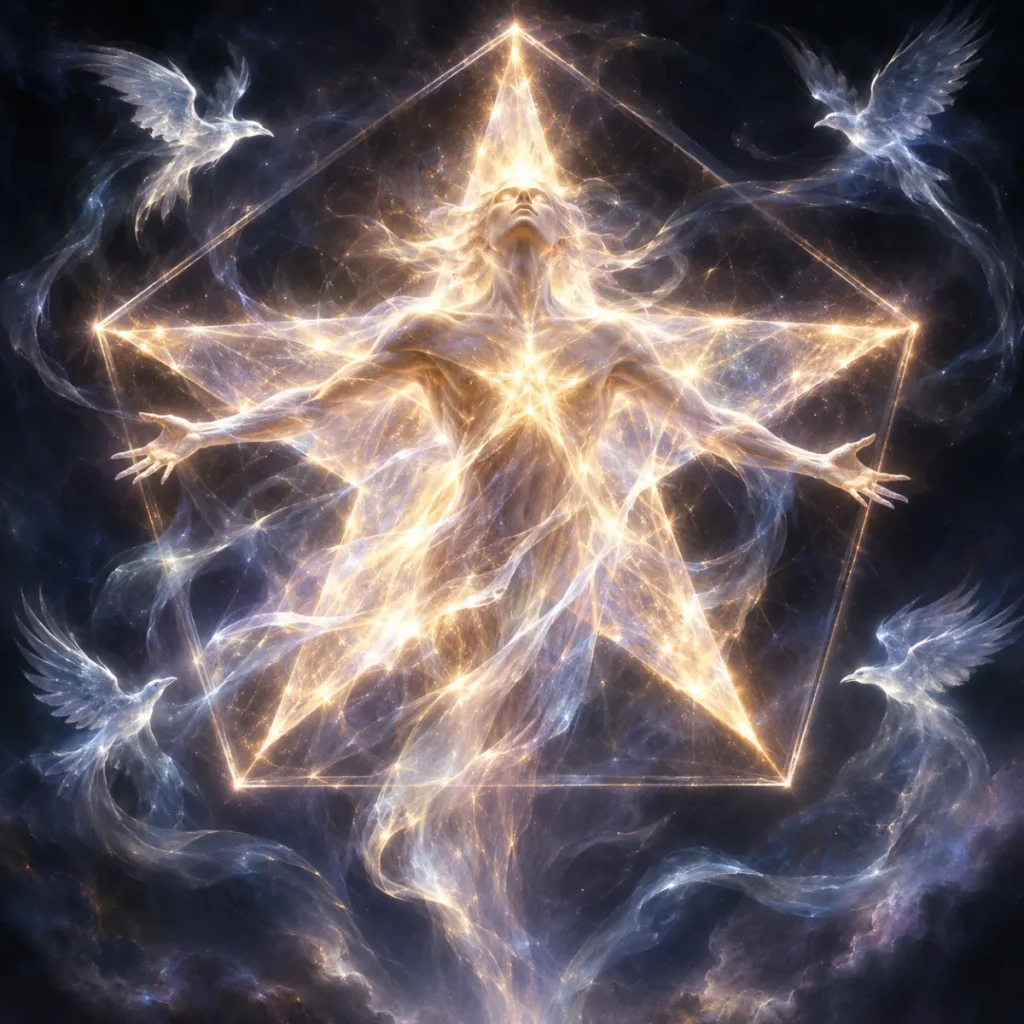
He arrives not as a beast or a warrior but as a star. Decarabia, the 69th spirit of the Ars Goetia, is one of the few in the catalog whose first form is not a living creature, and his office has something of the garden and the aviary about it: herbs, precious stones, and birds that sing and drink before the exorcist.
Who is Decarabia in the Ars Goetia?
In Joseph H. Peterson’s transcription of Sloane MS 3825, Decarabia governs 30 legions of spirits, “being himselfe a great Marquiz.” Curiously, the text leaves the rank for the end of the entry, almost as an afterthought. He holds place 69 among the 72 spirits of the Ars Goetia.
That rank, as we will see, does not match the one Johann Weyer gives him, a reminder that the book’s hierarchy is a matter of written tradition.
What does Decarabia look like?
According to Sloane 3825, he appears “in ye forme of a starre in ye Pentacle at first, but afterwards at ye command of ye Exorcist, he putteth on ye Image of a man.”
The expression is ambiguous. It could mean a star appearing inside the pentacle, the magical figure the grimoire describes later on, or a star shaped like a pentacle. Weyer is not much help: his printed text says only that he comes “like” a star symbol (☆). What the text does not say is that the star is luminous or celestial; those are added readings.
What powers does the grimoire attribute to Decarabia?
His office is “to discover ye vertues of hearbes and precious stones; and to make ye similitude of all Birds to fly before ye Exorcist, & to Tarry wth him, singing and Drinking as Naturall Birds doe.”
His knowledge of herbs and stones links him to Stolas, another spirit in the catalog associated with that lore of natural magic. The scene of the birds, by contrast, belongs to Decarabia alone. Both are attributions of the grimoire, not demonstrated abilities.
Decarabia in Weyer: King and Earl
In the Pseudomonarchia Daemonum (1577), the spirit is listed as “Decarabia vel Carabia,” number 52 in the catalog, with the same 30 legions. The main difference is the rank: Weyer calls him magnus Rex & Comes, a great King and Earl. Peterson notes that Reginald Scot’s English translation omits that title. The Ars Goetia, for its part, makes him a Marquis.
There is a second nuance. In Weyer, the birds fly before the exorcist and stay with him as if they were tame, drinking and singing after their fashion. The Ars Goetia speaks of “ye similitude” of the birds, which suggests figures rather than real birds.
Peterson also records other names in manuscript catalogs: Cambea and, in the Folger manuscript, Cambra, eleventh chief spirit under Amaymon in the South.
Decarabia’s seal
The manuscript says his seal is to be made and “worne as a Lamin before ye Exorcist.” In the grimoire’s general rules, the seals of marquises are associated with silver; if Weyer’s rank were followed, the result would be different, which shows how unstable these correspondences are.
What Decarabia reveals
Decarabia is a good example of how a spirit changes between catalogs: the name survives, but the rank shifts from King and Earl to Marquis, and real birds become likenesses. His image of star, herbs, stones and birds evokes an orderly, almost domestic natural world, far from the armed figures of other entries. That reading is ours; the text, as always, simply lists.
