
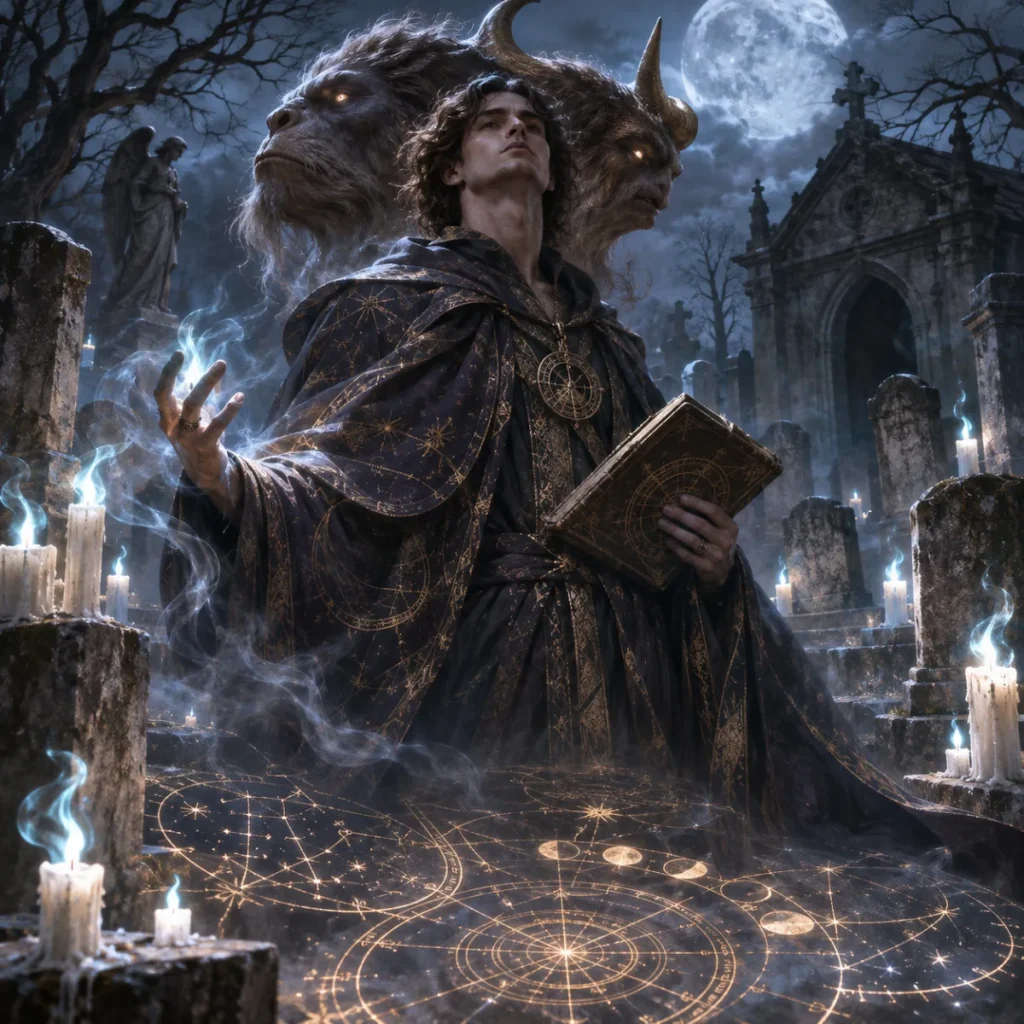
Candles that seem to light themselves on graves, and corpses that change their resting places. Few entries in the Ars Goetia carry such a graveyard atmosphere as Bifrons’s, even though much of his office is really that of a science teacher.
Who is Bifrons in the Ars Goetia?
Bifrons is spirit number 46 among the 72 spirits of the Ars Goetia. Sloane MS 3825, in Joseph H. Peterson’s transcription, gives him the rank of Earl (“an Earle”) and only 6 legions under his command, one of the most modest figures in the whole book.
That hierarchy, like the rest of his profile, belongs to the grimoire’s internal order: attributions of a text, not verifiable facts.
What does Bifrons look like?
The text says only that he first appears “in ye forme of a Monster” and that, after a while and at the exorcist’s command, he “putteth on ye shape of a man.” It never specifies what kind of monster.
That vagueness has left the field wide open for illustrators. Any concrete figure, whether horned, winged or two-faced, is interpretation, not text.
What powers does the grimoire attribute to him?
The teaching side is broad. Bifrons makes a person “knowing in Astrology & geomitry & other arts & siences,” and teaches “ye vertues of all hearbs, precious stones & woodes.” It is a profile close to that of Stolas, another spirit associated with plants and stones.
The funerary side is what made him famous: “he changeth ye dead Bodyes & putteth Them into one anothers’ places,” and “lighteth candeles seemingly upon ye graves of ye dead.” That “seemingly” is in the original: the text itself presents the lights as an illusion.
Bifrons in Weyer: a different rank, different legions
Bifrons is also number 46 in Johann Weyer’s Pseudomonarchia Daemonum (1577), under the same name. The differences are specific. Weyer gives him no rank at all; the title of Earl appears in the Ars Goetia. And where Sloane 3825 says 6 legions, Weyer says 26.
Weyer is also more precise about the teaching. Bifrons makes someone admirable in astrology, “absolutelie declaring the mansions of the planets,” as the English of Reginald Scot puts it, and does the same in geometry “and other admesurements.” The monster, the human form, the herbs, stones and woods, the corpses and the candles on the tombs all match in both versions.
What does the name Bifrons mean?
In Latin, bifrons is an adjective meaning “two-fronted” or “two-faced,” the classic epithet of the god Janus. It is reasonable to assume the spirit’s name comes from that word, but neither the Ars Goetia nor Weyer explains it, and neither describes Bifrons with two faces. The link to Janus is an appealing hypothesis, not something the text states.
Bifrons’s seal and what he reveals
The grimoire includes a seal for Bifrons, “wch he will owne and submit unto.” Beyond that detail, his entry brings together two worlds these books never kept apart: natural knowledge of stars, plants and stones, and a fascination with the dead and their tombs.
Read today, Bifrons tells us much more about the imagination of the people who copied these catalogs than about the real cemeteries of their time.
