
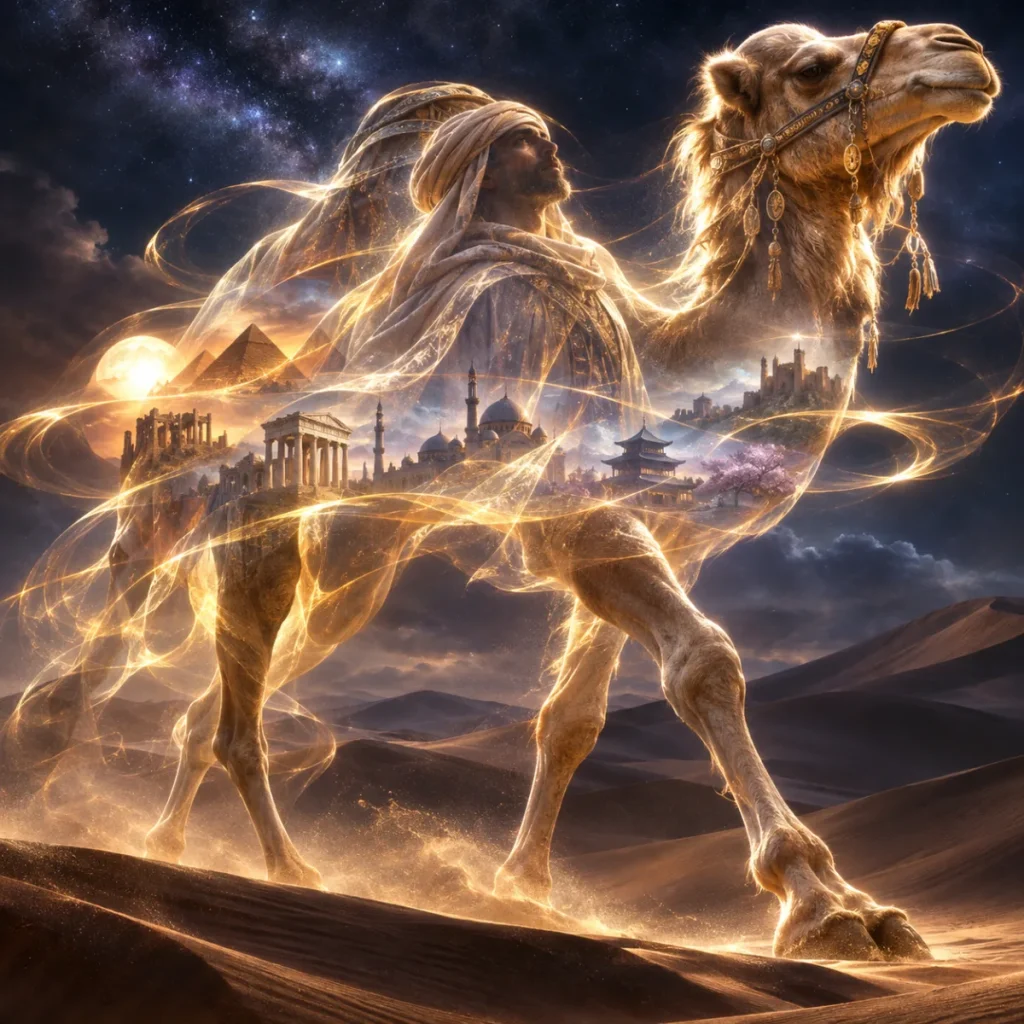
A huge dromedary that, on taking human form, starts speaking Egyptian. Uvall, called Vual in the manuscript behind the Ars Goetia, is a spirit of love and friendship with one of the most exotic entrances in the catalog.
Who is Uvall in the Ars Goetia?
Uvall is spirit number 47 of the 72 spirits of the Ars Goetia. In Joseph H. Peterson’s transcription of Sloane MS 3825 he is “a great & mighty strong duke” who governs 37 legions. The text adds a detail from his past: “he was of the order of Potestates,” one of the angelic choirs.
He should not be confused with Valac, spirit 62, whose name sounds similar but whose entry is completely different.
What does Uvall look like?
He first appears “in ye forme of a mighty dromedary”; after a while he puts on human shape “and speaketh in ye Egyptian Tongue, but not perfectly.” The text says nothing more: no clothing, no face, no gestures.
What powers does the grimoire attribute to him?
His office has three parts: “to procure ye love of women,” to tell things past, present and to come, and “to procure friendship betweene friends & foes.” In the book’s terms he is a spirit of affection and reconciliation rather than of technical learning. These are the grimoire’s attributions, not effects anyone has demonstrated.
Uvall in Weyer: the “imperfect” Egyptian that wasn’t
In Johann Weyer’s Pseudomonarchia Daemonum (1577) the spirit is number 66, under the name Vual; the 1660 edition prints Wal, and Reginald Scot’s English translation has Vuall. There the dromedary is “great and terrible,” the love he procures is “above all” the love of women, and both the order of Potestates and the 37 legions are confirmed.
The interesting difference lies in the language. Weyer writes that in human form linguam sonat Ægyptiacam graviter: he speaks Egyptian in a deep voice. Scot translated it as “he soundeth out in a base voice the Ægyptian toong,” base meaning low and deep. Peterson observes that the “not perfectly” of the Ars Goetia seems to be a misreading of that passage: what was a quality of the voice became a flaw in the language.
Peterson also notes that in the Folger manuscript (the so-called Book of Oberon) he appears as Ryall, under Paimon, King of the West.
Where does the spelling Uvall come from?
Neither Sloane 3825 nor Weyer writes “Uvall.” It is the spelling under which the spirit circulates in many modern lists and editions today, and the one most people search for. One possible explanation is that Vual or Vuall was read with its initial V taken as a U, letters that early printing used interchangeably, but the sources consulted do not document this. Uvall, Vual, Vuall and Wal all name the same spirit.
Uvall’s seal and what he reveals
The text includes a seal for Uvall, to be made and worn “as a Lamin.” Beyond it, the entry shows how a misreading can settle in for centuries: according to Peterson’s note, the dromedary who “doesn’t speak Egyptian well” was born from a deep voice that got lost in translation.
