
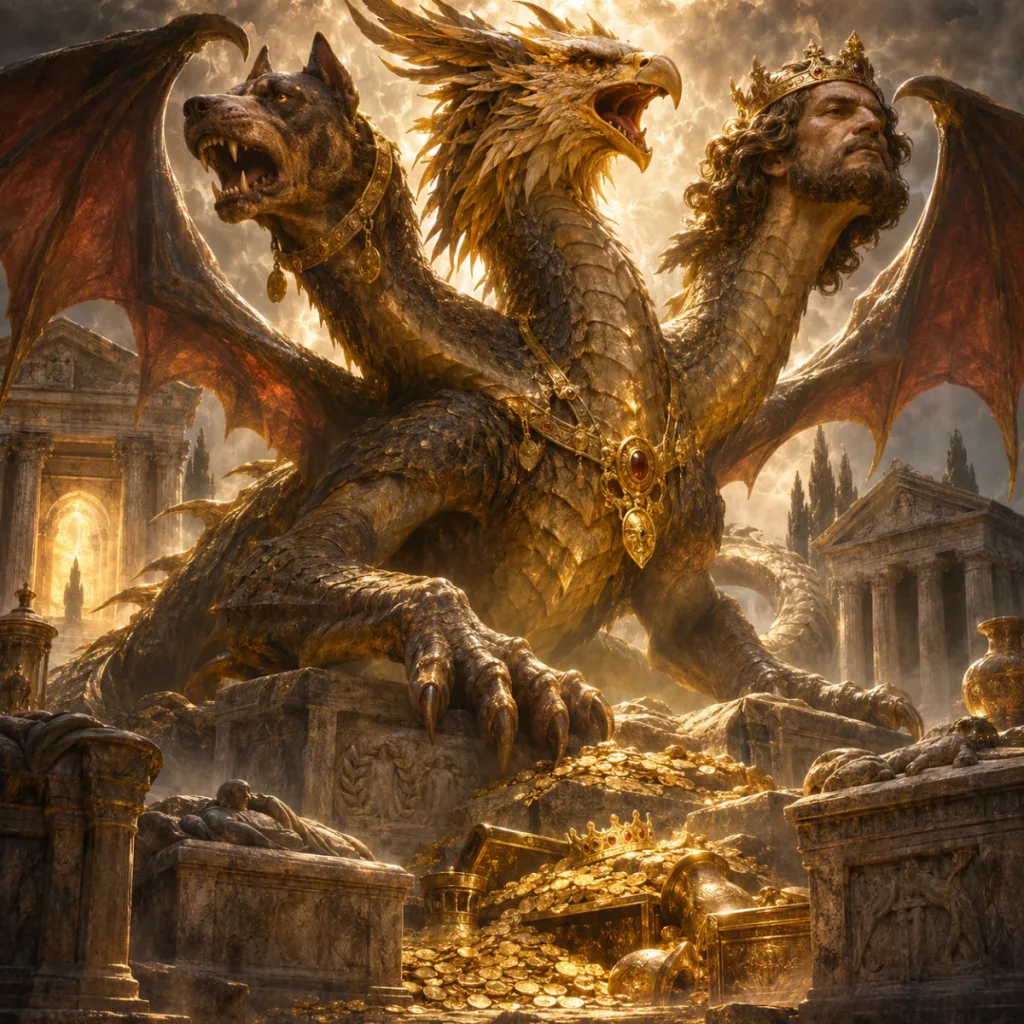
A three-headed dragon that moves the dead from place to place and gathers spirits upon the graves. Bune, the 26th spirit of the Ars Goetia, has one of the darkest entries in the catalog, though his main promise is thoroughly worldly: wealth, wisdom and eloquence.
Who is Bune in the Ars Goetia?
In Joseph H. Peterson’s transcription of Sloane MS 3825, Bune is “a strong, great and mighty duke” who governs 30 legions of spirits. He holds 26th place among the 72 spirits.
His titles and powers are attributions of the grimoire. They are described here as part of a historical text, not as real powers.
What does Bune look like?
According to the manuscript, he appears “in the forme of a Dragon with three heads, one like a dog, the other like a griffin; the 3d like a man.” He speaks “with a high and comely voice,” a detail at odds with his appearance.
He isn’t the only many-headed spirit: Aim, the 23rd, has three as well, those of a serpent, a man and a cat.
What powers does the grimoire attribute to Bune?
The Ars Goetia gives him two groups of functions:
- He “changeth the places of the dead, and causeth those spirits that are under him, to gather together upon their sepulcheres.”
- He “giveth Riches to a man and maketh him wise and eloquent,” and gives true answers to whatever he is asked.
The text speaks of riches in general. It does not mention hidden treasure, a power the catalog does assign to other spirits.
Bune in Weyer and the variant “Bime”
Johann Weyer includes him as number 24 of his Pseudomonarchia Daemonum (1577). The rank of duke, the three-headed dragon, the riches, the eloquence and the 30 legions all match. The differences:
- Weyer only specifies that the third head resembles a man’s; the dog and griffin heads are additions of the Lemegeton.
- The voice is described differently: where Sloane says “high and comely,” Reginald Scot’s English translation says “divine.”
- In Weyer it is demons in general, not just those under Bune, who gather upon the graves.
Peterson also notes that other manuscripts of the Lemegeton read “Bime,” apparently in error. One copy notes in the margin that this was the reading “in another copy,” and Mathers’ edition records both forms.
Bune’s two seals
Bune is an exception in the catalog: the manuscript gives him two seals. It adds a curious note: you may use whichever you like, “but the first is best as Salomon saith.” The detail shows that the copyists were already handling variants and trying to rank them.
What Bune reveals
Bune joins two worlds the grimoire keeps close together: the world of the dead and the world of prosperity. The image of a dragon presiding over tombs while enriching and lending eloquence to whoever consults him sums up the ambivalence of the whole Ars Goetia. Any symbolic reading of that link is modern; the text merely lists it.
