
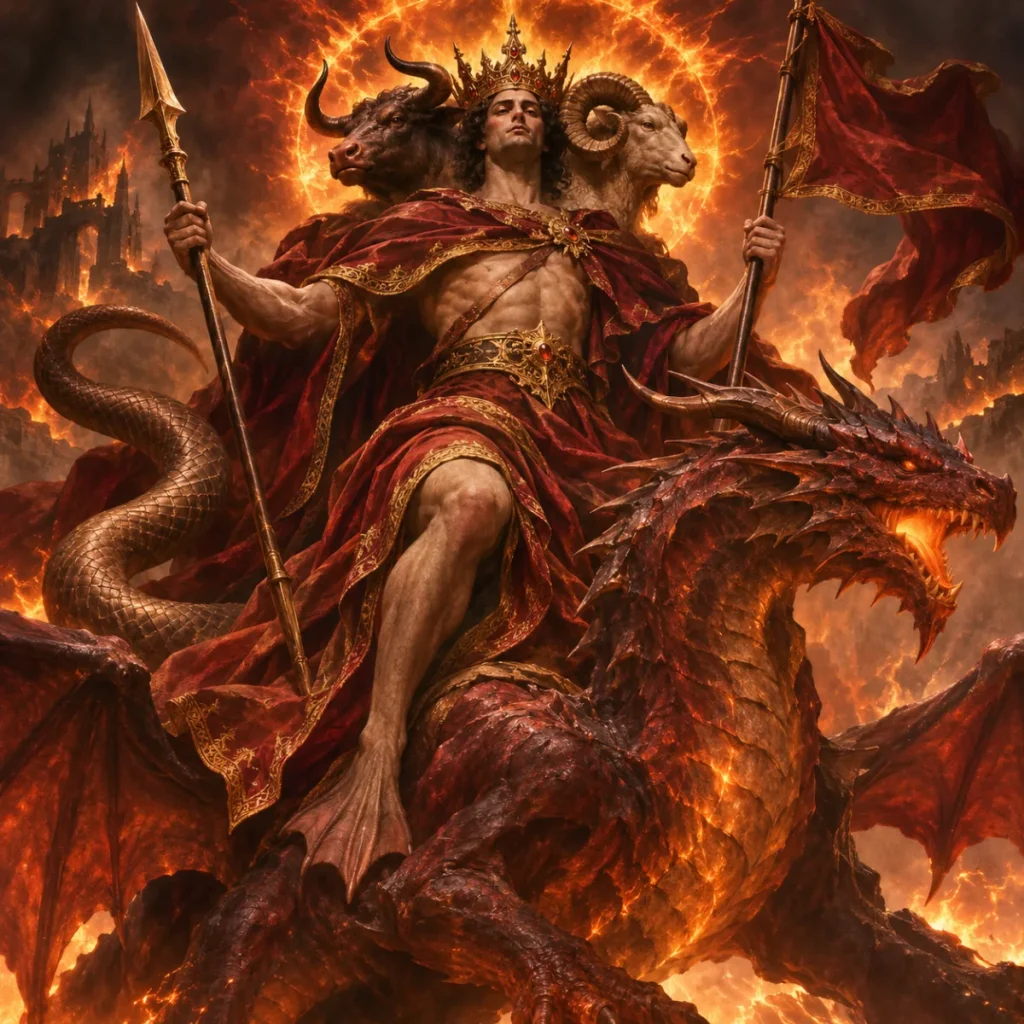
Three heads, of a bull, a man and a ram; a serpent’s tail, flames in his mouth, the feet of a goose and an infernal dragon for a mount. Asmoday, the 32nd spirit of the Ars Goetia, has one of the most elaborate images in the catalog and, paradoxically, one of its most sober curricula: arithmetic, geometry and astronomy.
Who is Asmoday in the Ars Goetia?
Sloane MS 3825, in Joseph H. Peterson’s transcription, presents him as “a great king, strong & powerfull,” with 72 legions of inferior spirits under his command, the same number as the full catalog of the Ars Goetia. It also gives him a precise place in the hierarchy: he is “ye first & chifiest under ye power of Amaymon, & goeth before all others.” Amaymon is not one of the 72; the grimoire itself names him later as one of the four kings of the cardinal points.
That same later passage, telling how Solomon shut the spirits up in a vessel, names Asmoday among the chief of them all, together with Belial, Beleth and Gaap.
What does Asmoday look like?
The description is meticulous. Asmoday appears with three heads, “whereof ye first is like a Bull The second like a Man, The Third like a Ram.” He has a serpent’s tail, is “Belching or vomitting up flames of fire out of his mouth,” and “his feet are webed like a Goose.” He sits on an infernal dragon, “carring a Launce and a flagg in his hands.”
The three heads are not a modern invention: they are in the manuscript and, before that, in Weyer’s Latin. Colors, crowns or wings, on the other hand, appear nowhere in the text.
What powers does the grimoire attribute to him?
Asmoday “giveth ye Ring of vertues” and teaches arithmetic, geometry, astronomy “and all handicrafts absolutly.” Peterson points out that the original Latin reads mechanicam, better translated as “mechanics” or “engineering.” He also gives true answers to whatever he is asked, “maketh a man Invisible,” and shows where treasure lies, guarding it if it belongs to the legions of Amaymon.
Like everything in the catalog, these are literary attributions of a magical text, not proven powers. And they are worth reading precisely: the text says he makes men invisible, not invincible, and it never explains how to make the ring. It only says that he gives it.
Asmoday and Sydonay: Weyer’s version
In Johann Weyer’s Pseudomonarchia Daemonum (1577), he is entry 35 under a double name: “Sydonay, alias Asmoday.” The description, the powers and the 72 legions all match. The interesting differences lie in the warnings the entry gives the operator, where the chain of translations produced some striking mistakes.
According to Peterson, the Latin told the exorcist to be brave (fit fortis), but the translator read foris, “outside,” and the English ended up saying “abroad.” Stranger still, a Latin phrase that, per Peterson, means “if he is afraid, he will be overwhelmed” became, in Reginald Scot’s translation, a warning about keeping one’s cap on: “if his cap be on his head.” Peterson calls it “a truly bizarre mistranslation,” and the Lemegeton inherited it as is.
Is Asmoday related to Asmodeus?
The name immediately recalls the Asmodeus of the Book of Tobit, and a connection between the two is a widespread hypothesis. Yet neither the Ars Goetia nor Weyer mentions it in these entries, and nothing in Asmoday’s description alludes to that story: here he is a king who teaches numbers, measures and stars. It is wiser to read him as the text presents him than to merge separate traditions into a single character.
His seal and why Asmoday matters
The manuscript says his seal is to be “worne as a Lamen before [thee] on your Breast.” For any reproduction, the most reliable source is a documentary edition of the manuscript.
Asmoday sums up the logic of the grimoire nicely: behind a nightmare image hides a master of the exact sciences. His entry is also a lesson in philology, because some of the book’s most quoted instructions were born of simple misreadings.
