
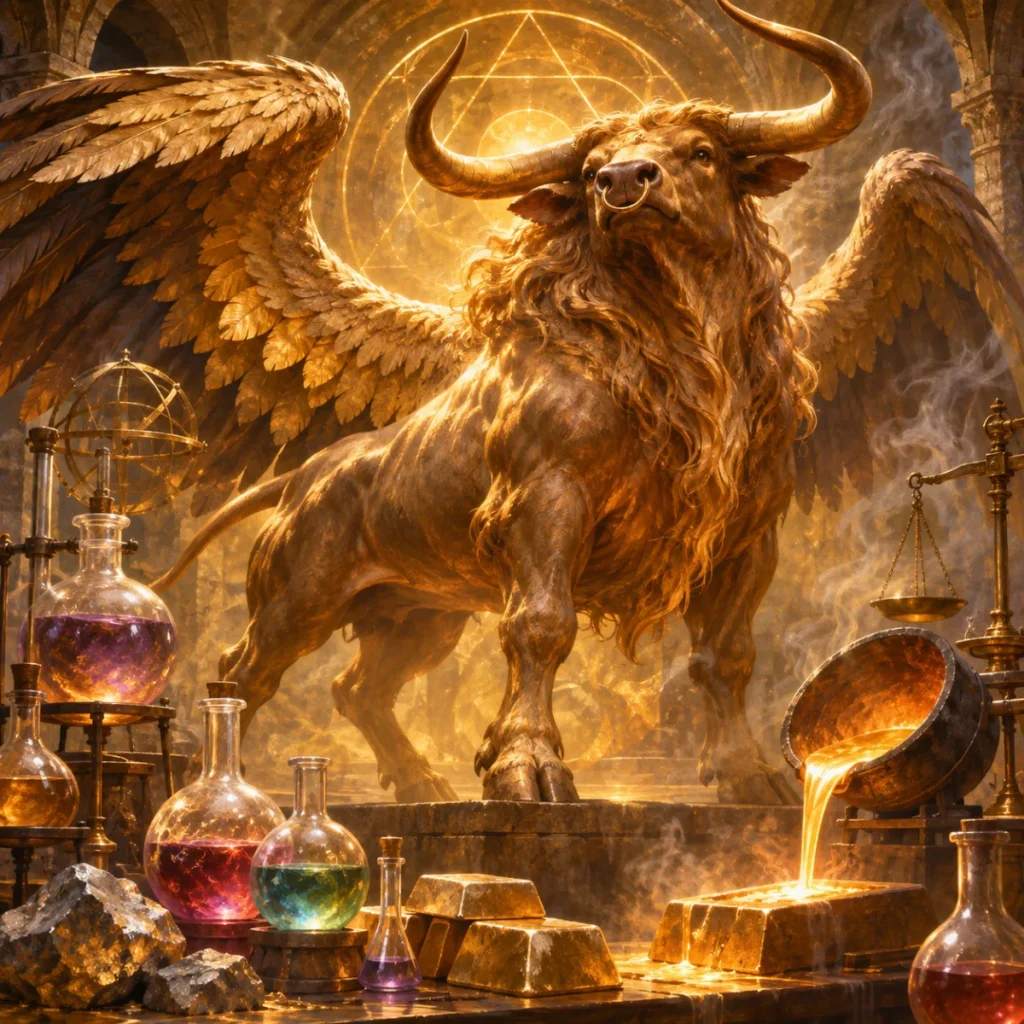
A bull with griffin’s wings that turns any metal into gold and wine into water. Haagenti gathers two very old dreams into a single entry: the instant wealth that alchemy chased, and the power to bend matter at will.
Who is Haagenti in the Ars Goetia?
Haagenti holds the 48th place among the 72 spirits of the Ars Goetia. Sloane MS 3825, in Joseph H. Peterson’s transcription, introduces him as “a great president” and credits him with 33 legions of spirits.
What does Haagenti look like?
He first appears “in ye forme of a mighty Bull wth griffins wings,” and afterward, at the exorcist’s command, he “putteth on humane shape.” There are no further details: the text describes neither the face nor the clothing of that second figure.
What powers does the grimoire attribute to him?
The text assigns him three offices: “to make men wise and to Instruct them in divers Things,” “to Transmute all mettales into gold,” and to “change wine into water, & water into wine.”
Turning metal into gold points straight to the classic goal of alchemy, and turning water into wine instantly recalls the Gospel story of the wedding at Cana. The grimoire comments on neither echo; it simply lists them as the spirit’s powers. They are best read for what they are: literary attributions, not procedures or promises.
Haagenti in Weyer, and his twin Zagan
In Johann Weyer’s Pseudomonarchia Daemonum (1577) Haagenti is number 67, third from the end of the list, with the same name and the rank of great president. The description matches: a bull with griffin’s wings, a human form, cleverness in every subject, metals turned to gold, water and wine exchanged for each other.
What is curious is how Weyer gives the number of legions. He does not write a figure at all; he says Haagenti “commandeth as manie legions as Zagan,” in the words of Reginald Scot’s English version. In the entry for Zagan (number 48 in Weyer and 61 in the Ars Goetia) the figure is 33, the same number the Ars Goetia gives Haagenti.
The cross-reference makes sense. Zagan also appears as a bull with griffin’s wings, also transforms metals (into the coin of the realm), and also turns water into wine and wine into water. The two entries are near twins, and the way Weyer links them suggests they were already being read as a pair.
Haagenti’s seal
Like the other spirits of the catalog, Haagenti has a seal of his own, which the text says to make and wear “as a Lamin.” Reproducing it faithfully means starting from an identified manuscript witness.
What Haagenti reveals
Haagenti shows how the grimoires gathered up the great aspirations of their age, such as the transmutation of metals, wisdom, or mastery over the elements, and placed them in the mouths of spirits. His kinship with Zagan is also a reminder that the catalog is not a collection of independent figures but a text full of duplicates, echoes and internal borrowings.
